Mesmeromania
It is impossible to conceive
the sensation
which Mesmer’s experiments created in Paris. Baron Du Potet de Sennevoy Mesmer appeared in Paris in the years leading up to the French Revolution, the Reign of Terror, the Age of Napoleon. In the words of Charles Dickens: “It was the best of times, it was the worst of times, it was the age of wisdom, it was the age of foolishness, it was the epoch of belief, it was the epoch of incredulity, it was the season of Light, it was the season of Darkness, it was the spring of hope, it was the winter of despair …” 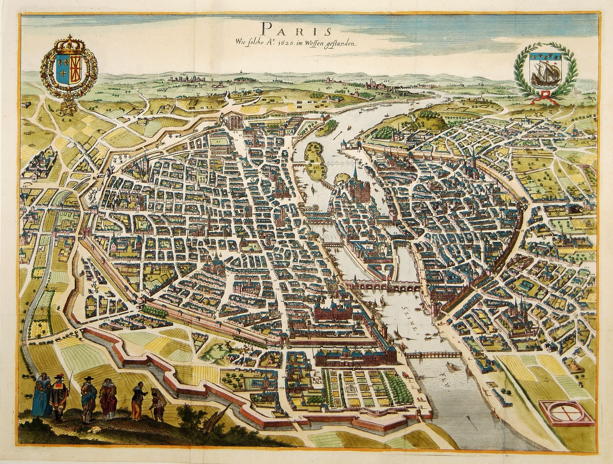 Paris – 1620
The Doctor intended to make only a brief stay in Paris. He expected that his Discovery would be received much more openly and intelligently than had been the case in Vienna. He imagined simply making demonstrations of animal magnetism, producing healing effects, and getting his just due at the hands of wise and prudent officials. Anton also expected that France would be a happier place for several months of his life. How wrong he turned out to be on both scores. Even after his Viennese experiences, Mesmer’s ever optimistic mind could not imagine the fear, jealousy, and vanity he would encounter in the face of scholars and physicians. As he later wrote, “The amount of nonsense put upon me is inconceivable.” It was as hard for Mesmer to fathom the treatment given him as it was for the academics to accept the wonders of animal magnetism and the alien from Austria. His appearance in the French capital coincided with incipient revolutions of many kinds. It was the Age of Reason, according to some. The Era of the Enlightened Mind to others. And Paris was THE center of so much of the change which was evolving rapidly on the continent. It was the largest (home to nearly 600,000 citizens) and the most enthralling city in all of Europe. Rich in many ways, poor in many others. Life expectancy was around 40 years. Few contemporaries realized that France, despite its standing in greater Europe, was in decline. “She was still the richest, most populous country in Europe. French had consolidated its position as the universal language; in the Holy Roman Empire rulers and nobility alike spoke it in preference to their native German. Copies of Versailles continued to be built by kings and princes throughout the Western world. And, to give some substance to the illusion France went on to make remarkable economic and industrial progress until the late 1770s.” (Seward) Paris had been the crossroads of Europe for untold ages. The city had so many prize-winning qualities. Yet even as France basked in the Enlightenment, Paris was also renowned for evil-smelling streets and its “thousand intolerable stenches.” The River Seine acted as sewer for the great city receiving all manner offal from slaughterhouses, tanneries, and poultry yards and from the excrement of humankind. The sewage created veritable swamps “on the banks that pollute the water used for washing or drinking by half the inhabitants of Paris.” The Capital of Europe was “world in which the Galerie des Glaces and the fountains of Versailles coexisted with the open sewers of the Ile de la Cité.” Pestilence was practically endemic and epidemics of cholera persisted to the middle of the 19th century. Death was never far away from Parisians. “Most of the graveyards have long suffered form a condition of overcrowding. They can neither hold more corpses nor decompose those that are there. All decomposition takes place practically in the open. The ground has become a pitted black mire from the constant process of decay.” (Horne) Matters came to a head during the winter of 1779-80 when mephitic matter began to seep into the cellars of buildings adjoining the Cemetery of the Holy Innocents. There was then fear for an epidemic and remains were gradually removed from all cemeteries within the walls of the old city. The air was as affected as the water by the pollution which generally produced a visible haze over Paris. Some areas were worse than others. The Marais district, which was often most offended and offensive, remained still one of the most fashionable quarters. Better wells and sewers were on the drawing boards, but they only began to become reality during the reign of Napoleon. Even into the next century, Balzac wrote regretfully that Parisians consumed barely seven liters of water a day. Londoners had use of ten times as much water. It wasn’t until the mid 1800s that even a modest number of Parisian households were connected to a rudimentary and clogged sewer system. In the midst of the earthy mire, great philosopher-scientists and inventors were at large in France and especially in Paris: Lavoisier, Laplace, Lagrange. The first encyclopedias were coming off the presses thanks to Diderot. Both Voltaire and Rousseau shuffled off their mortal coils in the year of Mesmer’s appearance. Benjamin Franklin, “discoverer” of electricity was ensconced in Paris from 1776 to 1785 as ambassador for the United States of America. The planet Uranus would be spotted in the heavens by the English astronomer William Herschel in 1781. 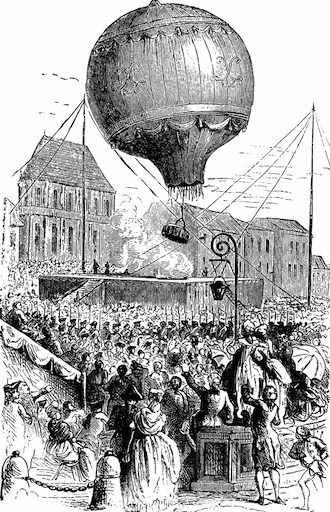 The Montgolfier brothers were soon to start flying their balloons (1783). Kant was preparing to publish his book on Pure Reason, but not all was close to reasonable. What was it that reason, science, philosophy, religion, superstition, quackery depended on? The perception and sometimes the exploitation of the material world. The Enlightenment was more than inventions, discoveries and writings. It was an intellectual climate: a cross between religious and political philosophy which had a bold stamp of the burgeoning science of the times. Newton and Spinoza and Rousseau set the pace while Montesquieu, Diderot, Voltaire and many others broadcast the revolution especially by means of a new encyclopedia of knowledge. It was said that most literate Frenchmen consulted the Encyclopédie, which could be studied at the new Masonic lodges or at the public reading rooms. That despite continuing attempts at censorship. The Philosophes wanted reform, not revolution. Their aims were to eradicate religious intolerance (of which the Jesuits were the most prominent symbol), to humanize the country’s barbarous medieval codes, and to set the state on a sound economic basis. They had no wish to destroy privilege, only modernize and update the creaking Ancien Régime to better serve wider strata of society including themselves. Parisians in the late 18th century viewed a different world than the one which meet our eyes today. They also saw and experienced things almost beyond our imagining two hundred years hence. They did as well as they could, considering the rapidly change scene, to make some sense of the array of animistic, vitalistic, electrical, chemical, and mechanistic theories that passed before their eyes. As always, there were to be winners and losers in the process. Numerous healers vied with physicians to attend to the sick and injured, the earnest and the gullible. So, Mesmer had competitors for his unusual methods. For sure, he was the most educated of healers in any time and place. But, his magnetic work was not unlike that used by a number of operators spread around the city. They seemed to be active everywhere, among the rich as well as the poor. Some even constructed their own baquets in emulation of Mesmer. The most famous of the indigenous healers used “the touch and the eye and thus treated thousands of patients at his office on the street of Sparrow.” Quackery was rife in the capital city. Much of the quackery was to be found within the structured medical profession and overflowing into the often self-medicated populace. Doctors very often prescribed drugs whose actions were virtually unexplainable. More often than not they really did not know what or why they were prescribing. Thus, they were often quite eager to get more experienced advice. Hence arose the custom of consultations of all kind, even by mail, as accepted practice in the period. Empirical medicine became more acceptable in mid-century, but the “professors lambasted quacks and empirics who deployed ‘untested’ drugs.” The interested public was used to swallowing drugs, but continued to look for something else. They were more impressed by results, whoever produced them, than by excuses. The educated and enlightened doctors did not stack up all that well even with their credentials. The mere existence of irregular practitioners called forth indictments of orthodox physicians for failing their community. Why did they fail? Voltaire gave a clear response to that question when he took major facets of current medical practice to task. He said, “Physicians prescribe drugs of which they know little, for diseases of which they know less, to patients of which they know absolutely nothing.” All manner of peddlers, con artists, and mountebanks had come and gone in recent years. Mesmer had often to bear being compared to many who resembled him and his work only faintly. Paris hardly boasted for its healers, but it did so for writers and salons. Its press was active and devoted to the sensational as in many places and times. But, it was relatively unaccountable and at utter unconcern for libelous presentation. Censorship was easily evaded. It was the beginning of a time of pamphleteering which spread across most of Europe. Anyone could write, publish, and distribute a pamphlet, speaking total nonsense, grave sedition or gross lies without threat. And, anyone could be made the butt of all manner of gossip and calumny. Materialism was empowered, even though the occult and the fantastic still held people – peasants to princes – to some account. The “Enlightened Ones” in their arrogance believed and decreed that only mathematically demonstrable and reproducible phenomena (much like in the present era) were truly valid. If the senses or machines of the Savants could not capture a thing, so as to identify it or reproduce it, then it was but a phantom. To all intents and purposes, it was non-existent. “They think [the Savants] they know the world, and do not know themselves; scales in hand, they weigh Saturn and its satellites, and cannot calculate the life of a gnat; they construct systems about the flux and reflux of the ocean tides, and are ignorant of how the sap mounts in the plant; they establish a mechanics of the Universe, and do not perceive the providential laws that are sustaining their own selves.” (Fabre d’Olivet) Science was in the process of replacing God, at the same time man was becoming a god. The reading public was intoxicated with the power of science. It gawked, became bewildered, and was sometimes awestruck. Neither the public nor the academics could distinguish the real from the imaginary. It seemed that each day was seized by a newly discovered fluid, a grand system theory, another cosmology to explain nature, improve life, and push disease and death back. Despite the flurry, the pronouncements of the Philosophes held sway. Not unlike the recent modern era, science appeared to be opening limitless vistas for human progress: “The incredible discoveries that have multiplied during the last ten years … have prodigiously extended the sphere of our knowledge. Who knows how far we can go? What mortal would dare set limits to the human mind?” Journal de Bruxelles 1784 It was not just a time of science and philosophy. It was the era of creative geniuses like Mozart, Goethe, Blake. But, they were not always and often appreciated. Those unique beings stood out from the crowd and paid the price. Though it was acceptable to be different, surely it was better to be different in degree, rather than in kind. Anton Mesmer was different in many kinds and degrees. His greatest difference may have been in his absolute confidence and commitment to his discoveries – which always came first. His own well-being and interests were of secondary import. But many could not help but notice that, “He brought with him the robust conviction that he deserved the homage of all mankind, homage due to the discoverer of a new force in nature which could cure all diseases and would eventually displace conventional medicine. He had an imperturbable sense of his importance to the world without a trace of modesty or humility.” Mesmer must have thought many times, “Ah! Paris: the City of Enlightenment, what better place to get the discovery known!” Arriving in Paris in February 1778 in the company of his surgeon friend Leroux and valet Antoine, the Doctor rented a house, even more imposing than his home in Vienna, on the Place Vendôme where many wealthy and powerful Parisians resided. His hotel was located near the modern day Ritz. Nearby was to be found the Café Royal which offered the finest wines of Burgundy and the best of company. “The Viennese doctor was saluted by the curious and the onlookers; one spoke of him in the galleries of the Palais-Royal, and from the Café du Caveau at the place Vendôme, circled the name of the innovator; because M. Mesmer knew the influence of the planets on the human body, the mysteries of the magnets and the power of the universal fluid.” Mesmer was almost immediately a conversation piece for rich dilettantes if not the scientific and medical establishment. Contemporaries were quick to note that Anton made an immediate impression on almost every one at first meeting. He was tall with broad forehead, noble and dignified. His large and solid presence exuded self-confidence. Vibrant health as well as magnetic power radiated from his pores. One admirer thought, “His soul like his discovery is simple, beneficent, and sublime.” The Doctor seemed always to be observing, taking mental notes, and sensing the environment around him. All eyes turned to stare at Mesmer and Gluck when they entered a Parisian drawing room. When making the rounds in Paris, Mesmer carried introductions from Gluck, who was one of Marie Antoinette’s favorites, as well as from the Austrian Ambassador. The Austrian government strangely showed itself supportive of Mesmer by providing him a letter of recommendation from Chancellor Kaunitz to Count Florimund Merci d’Argenteau, the Ambassador of the Empire in Paris. The Abbé Boulanger also sent him off with a letter of introduction. His German brothers in ancient and accepted Freemasonry opened the doors of French lodges for their Austrian fellow. The title of franc-maçon gave him entry to the portals of the Grand Orient, lodges of Nine Sisters, and meetings of Friends, of the Friendship and of Thalia. He visited but joined none of those French societies. Yet, his ties with those groups enabled him to meet philosophers, scientists and doctors who were members. Even better, Masonic friends eventually aided him to make contact with the queen. Thus prepared, he quickly managed to meet all manner of dukes and princes. He was well received except when it came to the scientific and medical communities. Wherever he went, Mesmer could not help but display his magnetic abilities to any and all who feigned even a little interest. His powers were recognized with few exceptions as when invited to the home of Baron D’Holbach, a physician and encyclopedist. Mesmer’s demonstrations were said to be complete failures and the Doctor did not attempt a return engagement. The evening did have a consolation as the Baron introduced Mesmer to Jean-Jacques Duval D’Epremesnil who became a dedicated follower of animal magnetism. Nonetheless, reports spread among admirers and detractors about his usually deliberate and successful powers. Thouret, an eventual denier of animal magnetism, wrote about a number of early incidents involving Mesmer in the outdoors. Once the Doctor was standing with two gentlemen around a pond. He asked them to put the tips of their canes in the water while he did the same with his cane on the other side of the pond. He then projected a current of animal magnetism through the water causing an attack of asthma in one man and a recurrence of a abdominal pain in the other. One day, two girls were running gaily behind Mesmer in a wooded area. He began to run also, and then suddenly turned and pointed his cane toward them. The girls’ knees buckled under them, and they could go no further. After Mesmer magnetized a tree in the garden of the Prince de Soubise, three ladies promptly fell to the ground, losing consciousness. Two others took hold of the tree and then could not release their grasp. The stories added one to the other. Before long, Mesmer was “assailed” by curious persons who had heard of his discovery and his powers as well as his cures accomplished in Austria and Bavaria and Hungary. But, rare it was to find any of the keenly interested garbed as doctors and scientists. 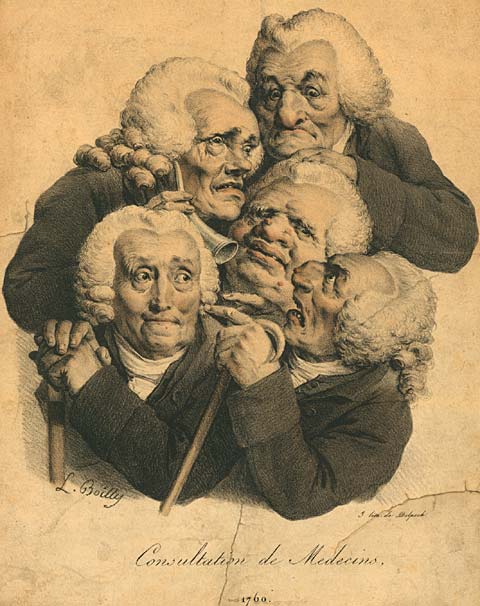
Consultations of Physicians – 1760
Anton pressed on to make direct contacts with the official companies as soon as possible. He quickly discovered that “dress and address” were of major import to savants and physicians. If a Frenchman was neither talented nor intellectual, his money could buy a title of nobility or one in the professions. All sorts of people were titled, and the fees to enter and be maintained within the noble class helped finance the Ancien Régime. Physicians often battled for the limelight publicly. But they tended to assemble in mass and huddle in consultation when their patients were in extremis. “The public believes that it is good for the relief of the sick that doctors assemble; what abuse! it is for the relief of the treating doctor, as our doctors say, to share the burden. When they have assembled, no one dares to undertake anything; one only offers small remedies that everyone can approve and which let the patient go quietly into the other world without risking the reputation of the doctor.” (La Mettrie) Mesmer found scholars much as physicians “occupied with the tips of the branches (of the tree of science), while neglecting to cultivate the stem.” In another metaphor, Mesmer “compared the Doctors to travelers lost on their way, who continue to stray farther away from the path rather than retracing their steps to get their bearings.” The Irishman Jonathan Swift might well have had Parisian medicine in mind when writing: With just Resentments and
Contempt you see
The mean Dissensions of the Faculty; How your sad sick’ning Art hangs her Head, And once a Science, is become a Trade. Her Sons ne’er rifle her Mysterious Store, But study Nature less, and Lucre more. It seems clear that by Mesmer’s time the art of healing had been corrupted in Paris, in France, in the whole of Europe. Physicians bowed to Nature in word, but rarely in deed – as they still do. They endeavored to deal with “Nature, that they know not, by the processes of an Art of which they know no more.” For all the centuries of practice, study and investigation by supposed medical and scientific geniuses, Medicine remained a very speculative and often ineffectual if not dangerous art. Mesmer tried to tell and show his confreres that Nature was the answer and that he had found a major key to its movement. “Medicine will ever only be a strange absurdity, a deadly superstition, as long as it will not be the result of conservative laws of man, which should not & can not be anything but a particular determination of the conservative laws of the Universe; & they deny me this truth!” The Art of Healing should have been and still should be a much simpler undertaking. Mesmer would have smiled at the French philosopher Michel de Montaigne, who wrote in the sixteenth century, “I do not know if the art of healing is found, nor if it will ever be found: what I know, is that it is not outside of nature; it is always natural that a man heals, that he falls ill; he can always as well heal suddenly, as die suddenly: all that one can say of certain healings, is that they are surprising; but not that they are impossible.” Through the Count de Merci, Mesmer was introduced to Charles Le Roi, Director of the Royal Academy of Sciences. Le Roi had only recently moved to Paris from Montpellier, which was considered to be the leading medical center in France. He was a learned professor specialized in the study of hearing and tended to researches in physiology and chemistry. For some time, Le Roi seemed accommodating and “appeared to appreciate the potential” of Mesmer’s discovery. He asked Mesmer to produce a written memorandum for the Academy. The Director even took the trouble to visit Mesmer at Vendôme and watch him work with a few patients. Dr. Mesmer had determined not to treat patients nor open a practice during his intended short stay in Paris. But, he dared not turn the ill and injured away. Neither his doctrine nor his humanity would allow him to do so. Mesmer wanted to share his discovery and be known as the physicist who changed the world of healing in the 18th century. The public was attracted to him even if the academics kept their distance. “His reputation for effecting extraordinary cures had the same effect here as everywhere else ““ – the ill found him out, flocked around him, and begged to be healed.” Anton Mesmer found himself in an uncomfortable situation from many angles, especially when he admitted his repugnance for doing consultations. “For myself, I find that my consultations appear too much like charlatanry. Examining the patients, touching them, but doing nothing to test them, or causing a few sensible effects, telling them my best the seat of their illness, and finishing, if I believe their cure is possible, by announcing that I then undertake to clear the problem, etc. There is only a little that happens in my consultations: it appears to me very little satisfying for the patient: and is highly tiresome for me. It would be impossible to continue indefinitely. It is a punishment to which one can condemn oneself at most two or three months. “Besides, the real healings in this manner are rare, and they have the disadvantage that they give rise to the most absurd tales. That reasonable people, at least they pass for such, come to see me with the opinion that I ought to suddenly heal with fingers to the eye, and then withdraw in anger that I did not fulfill their hope!” Mesmer had not only to deal with needy patients, vaporous hypochondriacs and grasping gawkers. Soon enough, his medical brethren got wind of his unusual but effective methods and tried in various ways to sabotage both Mesmer’s work and reputation. Early on, Baron Antoine Portal, a well-known Parisian physician, applied to Mesmer to be treated under an assumed name for a feigned illness. Dressed in the robes of a judge, he claimed to be a titled president of sovereign court. Disregarding the rest of the company, he revealed a complicated set of symptoms and subjected himself to magnetic treatment from Mesmer’s hands. Portal quickly pronounced that he was cured and departed. Ere long, he broadcast that Mesmer was without talent and, “could not tell a well man from a sick one.” The Baron published the story of how he duped Mesmer, thus showing the magnetist to be both foolish and ignorant. Modern readers might wonder who the real fool was. For a time, Dr. Mesmer’s work was limited due to circumstances and to intention. He had but a waiting room and a parlor; no baquets and only limited assistance. Neither did he spend time with bleeding and blistering. Still, Mesmer accomplished much with clients and word got out to the open-minded as he made his passes over patients and wrote prescriptions when necessary. The curious soon outnumbered the sick. He had to teach his valet Antoine to triage prospective clientele as they appeared at his door. Eventually, he trained the strong-armed Antoine as a toucheur who was highly praised by patients. None of his soon-to-be many patients were typical, as he tended those with scrofula, consumption, asthma, blindness, paralysis, melancholy and general nervous debility. Mesmer endeavored to bring each patient to a crisis of one kind or another upon which relief or restoration followed. A number of patients were even treated in the presence of their own regular physicians. From them all, or at least those who were cured, and there were many, he obtained written statements of treatment and result. He wrote M. Le Roi: “My principal object is to demonstrate the existence of a physical agent hitherto unobserved, and not to array against my discovery medical men whose personal interest would necessarily induce them to injure my cause, and even my person. It is as a natural philosopher myself, not as a physician, that I call on you, men of science, requesting you to observe natural phenomena and pronounce on my system.” Le Roi scheduled a meeting of the Academy with the intention of broaching the German physician’s theories to the august group. Mesmer was present but kept in the background for most of the proceeding. The proper Swabian was aghast at how the meeting was handled. The members showed little respect for M. Le Roi and it seemed less for each other. To Mesmer, the Scholars and Savants acted more like children than scientists in their conduct with regard to each others’ ideas and propositions. Eventually, Le Roi tried to share Mesmer’s story and discovery. The Director was prevented from reading through the whole of Dr. Mesmer’s memorandum and the assembly broke up leaving a mere dozen for Mesmer to address. He then was asked to give a demonstration of animal magnetism before the testy group. Reluctant though he was to proceed under the skeptical reception, Mesmer eventually operated on M. Adaelon, the Academy Secretary, when the group retired to Le Roi’s home. The patient who was subject to asthma seated himself in an armchair. While onlookers snickered around the edges, Mesmer soon influenced Adaelon magnetically, causing sensations in various parts of his body while standing at some distance. Members quibbled and tried to downplay the phenomena. Before long Adaelon was impelled into an asthmatic attack. But, the skeptics held sway until they left and just a handful remained to conclude the evening. Mesmer’s failure to impress scholars and physicians of the day would be repeated time and again. The sensible effects existed and were generally easy for him to demonstrate. But, it was difficult, often impossible to put the theory of magnetism into words acceptable to the savants. Mesmer fought the battle of words and language for most of his life. The conclusions of the Academicians could have been predicted. The Academy was even by then famous for its parochial conservatism. Their reaction was in keeping with recent and later rejections of Franklin’s lightning rod, Jenner’s smallpox vaccinations, and Fulton’s model for his steam vessel. Napoleon, who in a few years requested the opinion of the Academy regarding Fulton’s invention, eventually declared with obvious distress, “How foolish was I, not to have relied upon my own simple understanding, rather than upon the wisdom of the Academy!” Despite the difficulty, Le Roi accepted an invitation to visit Mesmer at his Place Vendôme apartment where patients were collecting. Le Roi appeared with M. le Comte de Maillebois and the Doctor made several demonstrations including one with a dropsical patient whose legs swelled and shrank before their very eyes at Mesmer’s command. Both Academicians were said to be astonished. But, they also admitted that they were unwilling to consider making any report because of the potential for ridicule by their fellows. The best Le Roi could do was to suggest that Mesmer put his truths into tangible evidence by treating, healing and documenting several diseases in patients after they had been examined by physicians of the Paris Faculty of Medicine. At the same session, Le Roi suggested that imagination may have been responsible for producing the dramatic changes they witnessed. Mesmer reacted both verbally and later in letter to M. Le Roi to his charge of imagination and seeming disbelief. “It was new to me to hear questioned such effects as I had just demonstrated for them. This pitiful objection came from the mouth of M. Le Roi.” Mesmer found himself piqued and challenged at the same time. The claim of imagination was sure to get his dander up. Desbois de Rochefort similarly poked at Mesmer’s work when he wrote, “great proof that the imagination plays the principal role in animal magnetism is the fact that persons not initiated in the mysteries have nevertheless produced effects in others, once they have convinced them that they have the secret.” Mesmer surely would have retorted that all have animal magnetism, affect their neighbors often without trying, and sometimes cure without any training at all. That was part of the secret. Le Roi’s comment caused Mesmer to react. He soon proceeded against his earlier plans to initiate the treatment of a number of patients with the intention of submitting their stories, treatments and results to the Academy. He resolved to find doctors who would be willing to look at patients before and after magnetic treatment and not focus his attention on the physics of his work. To better accommodate patients, he moved in May of 1778 to a house in Creteil, a village two miles east of Paris. His residence-clinic was more able to accept investigators and the crowds which were seeking his attentions. By August, Mesmer wrote the Director of Royal Academy of Sciences with reports on patients and their treatments as M. Le Roi had suggested. Le Roi made no response. Undeterred, Mesmer turned to the Royal Society of Medicine which was just in the process of being formed. The Society was preparing hopefully to stand equal to the old Faculty of Medicine as well as the Royal Academy of Sciences. The Royal Society, beginning as a 1776-commission [1775 and 1776 were years marked by numerous disease outbreaks in France] of medical police to study epidemics and epizootics, was soon transformed into a company with wider responsibilities and possibilities. The group was vying for place alongside the Faculty and was to get its letters of patent in 1778. 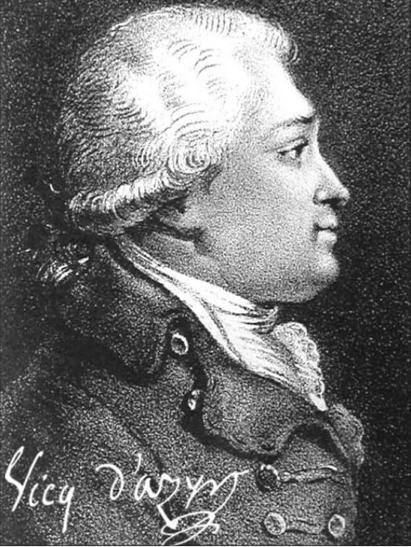 Vicq d’Azyr
The Royal Society of Medicine eventually challenged the Faculty to produce a medical revolution in Paris while agitating eventually to reign alone after the disappearance of her old enemy which was fallen in full decadence. “In her Plan of constitution for the medicine of France, Vicq d’Azyr (Perpetual Secretary of the Society) advocated the creation of an Academy of medicine charged with medical correspondence with the practitioners of the kingdom, with the examination of new remedies, with the study of the measures of public salubrity, with the fight against the epidemics, and with the meteorological nosography [description of diseases] which infatuated all the physicians of the era; it was the role that was already fulfilled by the royal Society: she had only to change the name – a slight sacrifice to the taste of the day for the innovations; it suffices of a simple approval of the power for the metamorphosis into Academy of medicine.” The rise of the Royal Society made it all the more clear that in the profession it was the “law of opposition and rivalry” which prevailed in Paris. Conflicts between practitioners were often rancorous, and base jealousies swayed behavior. Louis Peisse, writing in the next century, recognized that “scientific debates” often amounted to petty quarrels. Paris medicine much more exemplified medical politics than disinterested science. Doctors were out to make themselves into medical heroes and he thought it was unwise to take them seriously. Still, the Royal Society got off to a good start through the munificence of the Royal Treasury via a tax on mineral waters. This while the Faculty of Medicine only received modest monies from official funds, adding financial struggles to professional ones. The young Society quickly attracted attention through its supposed openness to new discoveries and remedies. It would not overlook novelties of the day which the Faculty might shun. Ever hopeful, Mesmer imagined that the Society might find interest in his magnetism. Yet from the beginning, the Doctor refused any commission under Society auspices because its mission was to review powders, liquors, and medicinals which physicians used. To evaluate the Découverte was really beyond the Society’s capability or any other orthodox institution, according to Mesmer. The problem was manifold. Animal magnetism was way beyond the boundaries of contemporary physicians and scientists (as it is today); few doctors believed and fewer had the sense required to work with the fluid; and many were vain pretenders to the truth. “They treat me with contempt because I expect of them that which requires wisdom in the administration of the truth.” The Society was willing to send a commission which was broached by the surgeon Leroux who had acted as Mesmer’s unintended agent. But Mesmer balked, eventually disavowing the step. He had only been in Creteil for twelve days when a word of warning about an unexpected visit came to the doctor’s ears. Confusion reigned on both sides when Mesmer rejected the visit before it occurred. In the midst of the turmoil, Mesmer offended important members of the new group. Still, the Society was willing to investigate Mesmer and his method. And, Mesmer was open to visitations from credentialed observers on his terms. The scientists quibbled and so did Mesmer. Though the Society seemed interested, it mandated that patients be fresh and untouched by other official bodies. Politics and turf boundaries were apparent to Mesmer. The Society would not deign to deal with patients who had ever been seen by members of the Faculty of Medicine. Nonetheless, the door to the Royal Society of Medicine seemed to open briefly to the German Doctor. While still living in Vienna, Mesmer had heard of the vaunted effects of the electrotherapeutic work of M. Maduit. Soon after arriving in Paris, Mesmer paid a visit to Dr. Maduit’s clinic and watched him at work. He quickly determined that the journal articles he had read had largely overstated the case. Still, Mesmer’s effort made contacts and he successively accepted visits at his own Creteil clinic from Drs. Mauduit, Andry, Desperrieres, and the Abbé Tessier, all Society members. Eventually, Doctors Andry and Mauduit were sent by the Society to officially investigate the entirely unorthodox newcomer. Mesmer sat opposite his patients, making grand passes with his hands, occasionally resting one on the patient’s abdomen and the other at the small of the back. He proceeded to work on one of Maduit’s epileptic patients. His passes soon produced a convulsion and then relief thereof. But, the investigators were quick to raise typical objections. Even when they were keen to admit that they knew little about epilepsy. “We are not sure of her diagnosis. And, who knows? She could just be feigning the attack to get attention.” Mesmer next sent reports and certificates from patients themselves to the Society via Vicq d’Azyr. The testimonials were returned with a note saying that the Society could not comment on patients unknown to them. Dr. Mesmer repeated his efforts a number of times and in various ways until he finally gave up after receiving one last letter from the Secretary saying: “This organization, which has had no knowledge of the previous state of the patients submitted to treatment by you, cannot state an opinion on the matter.” Mesmer persisted in expecting a highly accredited group to appear at his doorstep. The members of the group would be well disposed to him and his work, accept his conditions, be happy to study records written by patients, and listen and learn rather than criticize. Such a group never existed in France in Mesmer’s time – nor likely anywhere at any time. Dr. Mesmer was not merely distressed by societies, but also by the evasive and intrusive medical visitors they sent. He seemed most upset by the way they treated his patients. The doctors apparently played the parts of uninterested and sometimes disruptive interlopers amongst Mesmer’s patients. “Let’s bring to them more solid arguments, by lending for a few moments to head academicians and members a little less thoughtlessness and a little more love that may be well shown. Suppose that … these two companies (Academy and Society) were made to visit the village of Creteil and to behave with the dignity and the truth to make them envious of each other. They would have encouraged and not insulted the very small number of my patients, who by their inferior status were shy in front of them. By examining carefully and impartially the status of patients before their eyes, they would have been able to compare them with equal attention and an equal impartiality, to the state of the same illnesses previously recognized by the Doctors. In-depth reasoning, simple perception, innocence, the same enthusiasm of people questioned would have provided many points of clean comparison to sit in final judgment on the proposed question.” Without any substantive notice from official medicine or science, Mesmer fell back on other resources and methods. His reputation had preceded him and elicited the interests of the needy as well as the curious. The Doctor built up a considerable practice while waiting on one department of officialdom or another to notice him and his discoveries. He eventually put patient certificates to use. The academies were impermeable, the newspapers uninterested or antipathetic. So, Mesmer pressed the issue by publishing sworn statements from patients as to their illnesses, treatments by magnetism and subsequent cures. Some of his supporters followed suit eventually producing a large number of pamphlets which brought attention and converts. Influential people were numbered among the pamphleteers. Going around the system was sure to add to the chagrin and consternation of the medical and scientific orthodoxies. Before long, alarm spread through the medical community and professionals started their own pamphleteering. They also used journals which were generally closed to Mesmer, producing vitriolic attacks in the Journal de Médecine and the Gazette de Santé. Still, Mesmer was not afraid to use the options at hand. Among the published statements of Mesmer’s patients in this time period, one stands out most impressively and potently because of the station of the writer. Charles du Haussay, Major of Infantry and Knight of the Royal and Military Order of St. Louis, had suffered from typhus in the Indies and was a physical wreck. Broken in mind and body, he made his way to Dr. Mesmer. The following is an extract of Haussay’s testimony: After four years of useless experiments and the constant attendance of eminent physicians, among whom I can name several members of the Royal Society of Medicine of Paris, who personally know me and my case, I consented, as a last resort, to accept the proposition of Dr. Mesmer to try the proceedings of a method hitherto unknown. When I arrived at his establishment my head was constantly shaking, my neck was bent forward, my eyes were protruding from their sockets and greatly inflamed, my tongue was paralysed, and it was with the utmost difficulty that I could speak; a perpetual and involuntary laugh distorted my mouth, my cheeks and nose were of a red purple, my respiration was very much embarrassed, and I suffered a constant pain between the shoulder; all my body trembled and I staggered when walking. In a word, my gait was that of an old drunkard, rather than that of a man of forty. I know nothing of the means resorted to by Dr. Mesmer; but that which I can say with the greatest truth is that, without using any kind of drugs, or other remedy than “˜Animal Magnetism,’ as he calls it, he made me feel the most extraordinary sensations from head to foot. I experienced a crisis characterised by a cold so intense that it seemed to me that ice was coming out of my limbs; this was followed by a great heat, and a perspiration of a very fetid nature, and so abundant at times as to cause my mattress to be wet through. The crisis lasted over a month; since that time I have rapidly recovered, and now, after about four months, I stand erect and easy. My head is firm and upright, my tongue moves perfectly, and I speak as well as anyone. My nose and cheeks are natural, my colour announces my age and good health, my respiration is free, my chest has expanded, I feel no pain whatever, my limbs are steady and vigorous, I walk very quickly, without care and with ease. My digestion and appetite are excellent. In a word, I am perfectly free form all infirmities. I certify that this statement is in every particular conformable to truth. Given under my hand and seal, at Paris, the 28th of August, 1778. (Signed) Ch. du Haussay, etc. Dr. Anton Mesmer strangely continued to believe that with just one more effort the established powers would open to his discoveries and methods. Yet even his optimism was inevitably balanced with moments of saddened wonder. “In the month of September 1778, I was deserted. Everyone connected with scientific life avoided, maligned me, and told untruths about me.” “Conviction was formerly coupled with so much courage that men were willing to become martyrs, whereas nowadays men are unwilling to subject themselves to the slightest ridicule. Formerly men considered the strength to resist attacks as their greatest glory; now they fear nothing so much as to be considered too credulous. Formerly superstitious aberrations of thought did not prevent people from acknowledging strange facts, the causes of which mankind was too ignorant to recognize; one gave these facts the consideration due them, and even if one was deceived about the principles behind these facts, one did not deny the visible effects. Nowadays people tend to repudiate the visible facts so firmly that they remain as ignorant of them as they are of the unknown causes.” After a brief period of “irresolution,” he brought himself to recognize that, “I could no longer do what I had done before; but what part I should take I could not see.” At the same time, Mesmer inevitably made the acquaintance of Charles d’Eslon who became an ardent follower and enthusiast. D’Eslon was quickly taken with Mesmer and his animal magnetism after witnessing treatment of a friend. D’Eslon became Mesmer’s most medical, most educated and most confirmed supporter. Before long, Docteur-Régent d’Eslon displeased the Medical Faculty by the stands he took on Mesmer’s behalf. Still, he was little concerned because of his elevated station as personal physician to Louis XVI’s brother, the Comte d’Artois. Monsieur d’Eslon was a youngish, engaging doctor who soon understood that the German physician had developed a very important method, one that Frenchmen needed to recognize. After observing Mesmer for a time, he joined him on a daily basis for six months. D’Eslon persisted as a keen supporter and committed magnetist. Dr. Mesmer rose higher still in d’Eslon’s esteem as he personally attended the younger doctor. From the age of ten, I suffered from a pain in the stomach and could not bear any external pressure or jostling. It sometimes affected my breathing so that I had to undo the buttons of my vest. I also had headaches and a continual cold spot in my right temple. For a long time, I said nothing to Mesmer while observing his experiments. Then when I felt over-fatigued I asked him to play his harmonica or the piano for I found the music very beneficial. At last, I told him about my trouble and suggested that I should be treated if he could find an opportunity. ‘Good,’ he replied. ‘You come here every day, you are wise. You will have the treatment and keep it up as long as you like. If you do not obtain a complete cure, at least you will get half or a quarter or an eighth, and that will be so much gained.’ I followed his advice, and like the other patients, I had my crises, my evacuations, liver pains, racking head-ache, and in the end the skin of my forehead was peeling. I cannot say how long the treatment lasted for it had to be done at intervals. I felt very much better for it and could tap my stomach without feeling pain. D’Eslon discovered that physicians were not immune to crises after he passed through his own. During one of his treatments, Mesmer played the glass harmonica for d’Eslon. Even as he produced his ethereal music, Mesmer directed animal magnetism towards the young man. His doctor-patient eventually “begged for mercy” because of the turmoil (crisis) he felt roiling up inside himself. D’Eslon made it clear by his writings, by his stand with the Faculty of Medicine, and by his persistent efforts that he would do anything in his power to support and promote Mesmer’s discovery. For his part, Mesmer held d’Eslon in high regard – for years – and eventually wrote in his 1781 Précis historique des faits relatifs au Magnétisme animal [Historical summary of the facts relative to animal Magnetism] of him accounting “how truly rare a man M. d’Eslon is. Born sincere, he has the frankness of a pure soul and the heart which loves truth, that he holds in respect without blushing, and welcomes candidly! He speaks without giving offense, works consistently and firmly with the public without heat and without ostentation … I stopped myself. I have sacrificed my life to the happiness of mankind, and have assumed only now the duty to praise him as my friend.” Anton Mesmer found admirers in high places wherever he went. But, there always seemed a delicate balance to be walked between supporters and detractors. So too, it was among the four physicians who attended Louis XVI and his brothers during Mesmer’s time in Paris. Two of the doctors became ardent promoters of the German magnetist and two kept their distance from him and his work. Physicians to the King were Doctors Lieutaud and Lassonne. They also consecutively filled the position of President of the Royal Society of Medicine. Mesmer decided that, “Lieutaud was more inclined to believe nothing of what he had been persuaded previously than to let himself be convinced of what he had never believed…. Lassonne convinced me plainly that he was not taken to respecting my person and my discovery, more so when he was calculating the impossible circumstances to free himself of the prejudices that surrounded him.” Then, there was Caullet de Veaumorel, personal physician to the Comte de Provence, the other brother to Louis XVI. De Veaumorel slowly became a devotee of magnetism but did his discovery work quietly. He eventually composed Aphorisms de Mesmer … (1785) after attending and studying with Dr. d’Eslon, physician-in-ordinary to the Comte d’Artois. Charles d’Eslon was clearly Mesmer’s chief apologist and amanuensis, proxy and champion. He was for long-temps, the best imaginable disciple – a hard worker, a true believer, and a propagandist with influence in quarters where the master was persona non grata. He had a pleasing personality, graceful manner, and lively intelligence. Originally one of the bright young men of French medicine, he soon made his mark in the profession, rose to a distinguished place on the Faculty, and assembled a choice collection of patients from the aristocracy before becoming private physician to the Comte d’Artois. By late 1778, Mesmer had only one qualified and well-known Parisian physician to assist him, listen to him, study with him, and give him feedback in both his healing and scientific efforts. Yet with d’Eslon’s support, Mesmer took the presentation at which the Academy had hooted and produced his Mémoire sur la découverte du magnétisme animal. Mesmer’s treatise was first published in 1779 in Paris. It was exhibited in bookshop windows together with the author’s portrait done with a new process of color engraving which bolstered the book’s success. Alongside the portrait was a placed a brief verse which translates as: A thousand jealous minds in
vain wished you harm,
Mesmer, of your jealous care. Our ailments disappeared, humanity breathes. Pursue your glorious purposes Though jealousy growls; It is beautiful, it is great to be envied In making happiness in the world! The Memoir sold well, which helped its publication in Switzerland and Germany. But, that was hardly enough for Anton Mesmer. He continued to aspire to official recognition for his Discovery. This even though he admitted that, “Scholars declared the Memoir unintelligible.” Mesmer’s Memoir on the Discovery of Animal Magnetism including the 27 Propositions added to the arsenal he could present to bonafide inquirers. 27
PROPOSITIONS
1. There exists a mutual influence between the Heavenly Bodies, the Earth and Animate Bodies. 2. A universally distributed and continuous fluid, which is quite without vacuum and of an incomparably rarefied nature, and which by its nature is capable of receiving, propagating and communicating all the impressions of movement, is the means of this influence. 3. This reciprocal action is subordinated to mechanical laws that are hitherto unknown. 4. This action results in alternate effects which may be regarded as an Ebb and Flow. 5. This ebb and flow is more or less general, more or less particular, more or less composite according to the nature of the causes determining it. 6. It is by this operation (the most universal of those presented by Nature) that the activity ratios are set up between the heavenly bodies, the earth and its component parts. 7. The properties of Matter and the Organic Body depend on this operation. 8. The animal body sustains the alternate effects of this agent, which by insinuating itself into the substance of the nerves, affects them at once. 9. It is particularly manifest in the human body that the agent has properties similar to those of the magnet; different and opposite poles may likewise be distinguished, which can be changed, communicated, destroyed and strengthened; even the phenomenon of dipping is observed. 10. This property of the animal body, which brings it under the influence of the heavenly bodies and the reciprocal action of those surrounding it, as shown by its analogy with the Magnet, induced me to term it ANIMAL MAGNETISM. 11. The action and properties of Animal Magnetism, thus defined, may be communicated to other animate and inanimate bodies. Both are more or less susceptible to it. 12. This action and properties may be strengthened and propagated by the same bodies. 13. Experiments show the passage of a substance whose rarefied nature enables it to penetrate all bodies without appreciable loss of activity. 14. Its action is exerted at a distance, without the aid of an intermediate body. 15. It is intensified and reflected by mirrors, just like light. 16. It is communicated, propagated and intensified by sound. 17. This magnetic property may be stored up, concentrated and transported. 18. I have said that all animate bodies are not equally susceptible; there are some, although very few, whose properties are so opposed that their very presence destroys all the effects of magnetism in other bodies. 19. This opposing property also penetrates all bodies; it may likewise be communicated, propagated, stored, concentrated and transported, reflected by mirrors and propagated by sound; this constitutes not merely the absence of magnetism, but a positive opposing property. 20. The Magnet, both natural and artificial, together with other substances, is susceptible to Animal Magnetism, and even to the opposing property, without its effect on iron and the needle undergoing any alteration in either case; this proves that the principle of Animal Magnetism differs essentially from that of mineral magnetism. 21. This system will furnish fresh explanations as to the nature of Fire and Light, as well as the theory of attraction, ebb and flow, the magnet and electricity. 22. It will make known that the magnet and artificial electricity only have, as regards illnesses, properties which they share with several other agents provided by Nature, and that if useful effects have been derived from the use of the latter, they are due to Animal Magnetism. 23. It will be seen from the facts, in accordance with the practical rules I shall draw up, that this principle can cure nervous disorders directly and other disorders indirectly. 24. With its help, the physician is guided in the use of medicaments; he perfects their action, brings about and controls the beneficial crises in such a way as to master them. 25. By making known my method, I shall show by a new theory of illnesses the universal utility of the principle I bring to bear on them. 26. With this knowledge, the physician will determine reliably the origin, nature and progress of illnesses, even the most complicated; he will prevent them from gaining ground and will succeed in curing them without ever exposing the patient to dangerous effects or unfortunate consequences, whatever his age, temperament and sex. Women, even in pregnancy and childbirth, will enjoy the same advantage. 27. In conclusion, this doctrine will enable the physician to determine the state of each individual’s health and safeguard him from the maladies to which he might otherwise be subject. The art of healing will thus reach its final stage of perfection. Increasing numbers wanted to experience the ministrations and the vital force of Anton Mesmer which impelled the Doctor to leave Creteil, return to Paris, and take possession of the Hôtel Bullion on the Rue Coq Heron. The suite of apartments was opulent and spacious. Previous occupants had there entertained the beau monde of Paris. Mesmer’s manse had high ceilings, inlaid floors, and oriel windows. “Richly-stained glass shed a dim religious light into his salons.” The paneled walls were largely covered with full-length mirrors placed between paintings of Blanchard and Vouet. Flowers, orange blossoms and incense comforted noses and silence generally reigned until the Master directed otherwise. The furnishings, which accommodated a large number of patients, were in the finest style of Louis Quinze, from the artwork on the walls and tables to the chairs in which the patients sat while they were being magnetized. Mesmer had two allegorical tableaus especially painted and placed strategically. They symbolically explained his discovery and the impending ruination of Medicine. “The first, that one finds in the first room, in entering by the little stairs at right and near to the crosses, is a design of twenty inches on sixteen, washed with Chinese ink, raised from white, representing a great young man nearly nude, a flame on the head, the right hand extended above with the Goddess seated at the feet with a cylindrical altar, having for inscription these words: Animal Magnetism. One carries to this Goddess the sick on the stretchers: in the bottom at right, is a temple in round adorned with columns, around which is a group of figures; one sees on the left, another Divinity enveloped with clouds, overflowing from the left a mortar of an apothecary, and from the right holding a sparkling lightning which launches at two figures struck down, nude, hideous; and such that one represents them as the Furies; one of them holds then the pestle of a mortar, and broken by its fall two antique vases, on which are engraved theriac & quinine. In the bottom, & in the half-tint, is perceived a man in wig, & in long robe, and seizing the right hand Death who accompanies him. At the base of the tableau & on one of the stones of ruins with its edifice is written large letters, MEDICAL SCHOOLS. “The second tableau, of almost the same grandeur, at left of the door of the room of crises, represents for principal figure a woman who has the moon on the head, with a crown of stars; she holds in the hand a wand similar to the one by which treatment is done at the house of M. Mesmer, & engraved at the base with an ancient and truncated pyramid, and this inscription, ANIMAL MAGNETISM OF IMMORTAL MESMER. The pyramid is covered with hieroglyphs, & at the top is a phoenix in its blaze. At the base, are the little group of Genie, tracing the circles of the different planets. A little to the left, one perceives the patients who implore the salutary aid of this Goddess; & farther is a draped woman, carrying her child who has the rachitic air. The scene is lighted by the moon in full and in the bottom, there are groups of children occupied to break the pots filled with drugs.” (Paulet) Despite its grandiose trappings, Mesmer’s new home was said to be considered one of the most charmingly appointed homes in all of Paris. It emoted an atmosphere which crossed between church and theater. The Doctor staffed his townhouse with a doorman, coachman, two servants, and Anthony. Swiss Guards stationed nearby were compensated for keeping the traffic of carriages circulating while a small orchestra appeared every day. Anton Mesmer knew how to attract money, so his hotel expenses of twenty thousands francs a year were easily handled. He netted around eighty thousand without including donations from generous clients. In short order, patients and public watchers were attracted in droves. Excitement reigned. Even a foreigner could recognize that Mesmer and his practices were in fashion: “Le magnétisme animal considére en grand, est dans ce moment le jou-jou le plus à la mode.” [See below.] The physician Jean-Jacques Paulet wrote at length to discredit or at least detract from the works and successes of Anton Mesmer. Like other critics, he seemed to produce some of the opposite effects when taking Paris’s new plaything to task. “This taste for the veiled things, for mystical, allegorical senses, has become general in Paris, & occupies today nearly all the people of ease. There is only the question of associations to great mysteries. The Lyceums, the Clubs, the Museums, the Societies of harmony, &c are so many of the sanctuaries where one must only occupy himself with abstract sciences. All the Books of secrets, all those which treat of the Great Work, of the Mystical, Cabalistic Sciences, are the most researched. But animal Magnetism considered in a big way, is in this moment, the toy (joujou), most in fashion & that which makes the most heads turn. It is this animal Magnetism which has caused a believer to announce himself as the first to say, that the titles of Man of genius & of Benefactor of humanity can not leave him; which has made him to refuse, after his avowal, twenty thousand livres of pension that the Government offered him; which attracted to his house a party of the Court & of the City; finally which has valued the honor for him to count among his Partisans, Students, Adepts or Neophytes, the Savants, the Physicians, the Personalities distinguished by the Sword, by the Robe, etc. All these facts, when they will come only to serve in clarifying fro the future, merit being consigned in some writing.” Paulet wrote two books intending to satirize and diminish Mesmer. But, he often put the German healer’s work into bright contrast with that of the orthodox practitioners of the day. In Mesmer Justifié, Paulet drew a colorful picture of Mesmer’s workshop: “In effect, is it nothing more glorious than this brilliant concourse of men, of horses, of carriages, this whirlwind, this fracas which pleases so many, which reigns from morning to night at the house of Mesmer? How does one compare this continual movement to those grave assemblies of Physicians, to those mute consultations which resemble the meditations on the dead; which could sway the choices? From one side these are only noisy and marvelous objects, from the other the objects somber or sinister, a frightening show, of words interspersed, with a strange language, of glances fiercely projected by men dressed in dark on a horrified patient, of the dark and disgusting drugs; here, to the contrary, the physician in lilac or purple habit [with ruffles of lace at the writs, shining buckled shoes, and topped with powdered wig], where hand has painted the flowers the more brilliant, holding to his patient the intention the more consoling; his arms gently enlaced sustaining her in her spasm and his ardent and tender eye expresses the desire which he has to relieve her. The horrific Pharmacy is always excluded, the crystal of one pure wave there replaces the poisons, and the dexterity to carry it to a pink mouth of rose gives him all his effect. “The house of M. Mesmer is like the Temple of the Divinity which gathers all the classes; one sees there the cordon bleus, the abbots, the marquises, the working girls, the soldiers, the contractors, the upstarts, the physicians, the young girls, the accoucheurs, the men of mind, the wigged heads, the sick ones, the strong and vigorous men, etc., all drawn there by an unknown power. There are the magnetic bars, the inscrutable baquets, the wands, the cords, the flowered and magnetized bushes, diverse musical instruments, among others the [glass] harmonica, from which the fluted tones awakening the ones, giving a lightness to abstract the others, exciting the laughter and sometimes the tears, you add to these objects the allegorical paintings, the quilted cabinets, the peculiar premises designed for the crises, a confused melange of crisis, of hiccups, of sighs, of songs, of groans. One is forced to admit that this new kind of spectacle is very fascinating and that it must be nothing less than a great genius to produce it. “Also one only finds at the house of M. Mesmer beings delivered to pleasure or to hope, the patients themselves becoming there radiant, there taking an air of gaiety, of freshness; the jaundiced clarifying themselves; the eyes speak there, and until the silence, everything is expressive there and like the supernatural. It is true that this silence finds some interruptions all of a sudden by the noisy crises; there is a convulsion which takes a person; it takes five or six to hold her; but this does not last; one calls M. Mesmer, who, most often occupied to contemplate the stars, blends with nature, takes it as fact, and does not appear; but a crowd of his disciples, assumes the power of their master, replaces him, takes hold of the patient, gradually calms the impetuous fugue of her nerves, and seems to command nature, astonished to see it vanquished for the first time; everyone leaves this Temple with a new dose either of life or of health, or of gaiety or of rapture.” Excitement and expectation, compliments and thanks abounded for those who have attended Mesmer’s Temple. And, they covered a wide spectrum of Parisian society. Practically no part was exempt except for the Savants, who came but could not or would not see. Melchior Grimm could not help but note that, “He has had the honor of finding the most enthusiastic admirers, the most opinionated opponents, and patients the most submissive or credulous.” Even outsiders and bystanders were apt to notice patients departing from Chez Mesmer: “I give you my compliment, said one to them; you carry yourself to rapture; one sees well that you have been to the house of Mesmer; you are radiant; it is an astonishing man this Mesmer.” The onslaught of the ill, real and feigned, seeking his aid became so great that he found it impossible to attend them all personally. Mesmer had medical assistants including d’Eslon, but more help was needed. He had to quickly nvent a method to work with numbers of patients at the same time. His studies in Vienna led him to the perfect solution: the baquet. After the aura of Mesmer himself, it was the baquet which most engaged the attention of patients and visitors. 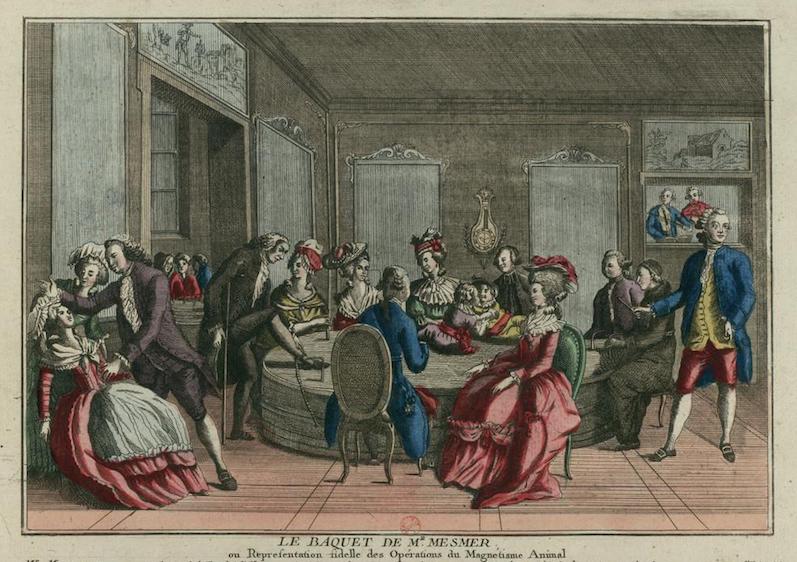 In the middle of a large room stood an oak tub, four or five feet in diameter and one foot deep; it was closed by a lid made in two pieces, and encased in another tub or bucket. At the bottom of the tub a number of bottles were laid in convergent rows, so that the neck of each bottle turned towards the centre. Other bottles filled with magnetized water tightly corked down, were laid in divergent rows their necks turned outwards. Several rows were thus piled up, and the apparatus was then pronounced to be at high pressure. The tub was filled with water, to which was sometimes added powdered glass and iron filings. There were also some dry tubs, that is, prepared in the same manner, but without any additional water. The lid was perforated to admit the passage of movable bent iron rods, which could be applied to the different parts of the patients’ bodies. A long rope was also fastened to a ring in the lid, and this the patients placed loosely round their limbs….. The patients then drew near each other, touching hands, arms, knees or feet. The handsomest, youngest and most robust magnetizers held also an iron rod with which they touched the dilatory or stubborn patients. The rods and ropes had all undergone a preparation, and in a very short space of time the patients felt the magnetic influence. The women, being the most easily affected, were almost at once seized with fits of yawning and stretching; their eyes were closed, their legs gave way, and they seemed to suffocate. In vain did musical glasses and harmonicas resound, the piano and voices re-echo, these supposed aids only seemed to increase the patients’ convulsive movements. Sardonic laughter, piteous moans and torrents of tears burst forth on all sides. The bodies were thrown back in spasmodic jerks, the respirations sounded like death rattles, the most terrifying symptoms were exhibited. Then suddenly the actors of this strange scene would frantically or rapturously rush towards each other, either rejoicing and embracing or thrusting away their neighbors with every appearance of horror. Another room was padded and presented a different spectacle. There women beat their heads against the wadded walls or rolled on the cushion-covered floor, in fits of suffocation, in the midst of this panting, quivering throng, Mesmer, dressed in a lilac coat, moved about, extending a magic wand towards the least suffering, halting in front of the most violently excited and gazing steadily into their eyes, while he held both their hands in his, bringing the middle fingers in immediate contact, to establish the communication. At another moment he would, by a motion of open hands and extending fingers, operate with the great current, crossing and uncrossing his arms with wonderful rapidity to make the final passes. It was said that at the baquet, a swaying, rhythmical movement commonly communicated itself from one person to the next. With a sharp cry, a woman was seized by convulsions and soon another fell to the floor, twitching and shaking in every limb. “The Parisians call it ‘l’enfer des convulsions [the hell of convulsions],’ and perhaps they are right. But I (Mesmer) prefer to think of it as a purgatory through which those must pass who leave their old ailments behind, in the limbo of forgotten things. You too will forget the pains you used to suffer. Your disease is due to the fact that you have thrown your system out of equilibrium, and it will vanish when equilibrium is restored.” Mesmer’s new establishment at the Hôtel Bullion had room for four baquets, one of which was reserved for the poor. But early in this period, Mesmer spread his work to the out-of-doors. The poor were reticent to enter his rich apartments and the outdoor alternative had advantages. There adding to his reach and fame, the Doctor magnetized a large oak tree on Rue de Bundy through which he could touch many of the poor sick ones at a time. Patients attached themselves by ropes of vegetable fibers hanging from its branches to attract its magnetic healing energy. Not content to heal the poor
animals
He takes then the hand to the lowly plants. He magnetizes a tree and the dying sap Soon returns vigor under his beneficent hand. Mesmer does still more, because his creative finger With a tree whatever it be can make a doctor for us Also savant as he, whose sanitary influence Can heal a malady at some distance. The grand tree on the boulevard attracted large crowds. Some needed healing; others wanted to experience the new phenomenon. The Journal de Paris reported, “We saw over a hundred people experience the effect of magnetism after they had kissed the tree … Could M. Mesmer do better?” The magical tree kept its leaves until the beginning of the winter; in spring, it was the first to be covered by leaves. 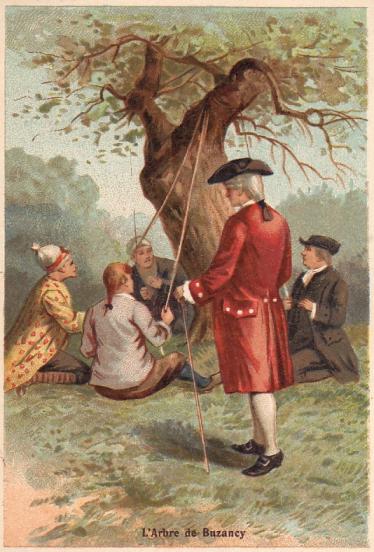 Again, Mesmer foreshadowed things to come with his magnetized baquet and tree. The Spiritualists of the next century, in effect, would form their own magnetic chains at seances. The magnetic forces produced in those cases, instead of energizing patients, vitalized the medium sitting at the center of the assembled group and produced manifestations of many kinds. Most of Mesmer’s indoor patients were well-to-do. But, he never turned his back on the ill regardless of class and situation. He may have enjoyed his riches, but he also appreciated and accepted all comers. “I am not astonished that the pride of persons of high birth should be wounded by the mixture of social conditions found at my house; but I think nothing of it. My humanity encompasses all ranks of society.” One of Mesmer’s many disappointments during his time in Paris surrounded the careless treatment of the poor. He complained that, “No one encouraged me to treat people who were not prominent in society. But despite the obvious advantages of such a policy, I could not accept such a sad slavery.” The Paris Faculty of Medicine prided itself on providing a free clinic every Saturday from ten to noon after Mass of the Schools. Bachelors escorted the dean and six regent doctors as they gave consultations to the poor. The free gift was but a pittance of assembly-line care for the thousands who were in need. The city of Paris had a number of hospitals at the end of the 18th century. But, they were set up more for housing the poor, proselytizing the wayward, promoting moral and religious education, providing charitable outlets for the religious, and protecting society at large. Fenelon had addressed Louis XIV in 1694 saying, “Your people are dying of hunger … France is nothing but a vast hospital.” For those kinds of people, little had changed over the course of a century. Even the hospitals were in dire condition; often unsanitary and dangerous. The Salpêtriére was appallingly overcrowded. At one time, it housed ten thousand inmates as it became a prison for prostitutes and eventually a lunatic asylum where the insane were chained to the walls. The Hôtel-Dieu was not noted for its care but for lack of hygiene; disorder, dirt and dilapidation: “dangerous focus for disease; in the most terrible hygienic conditions, a huge population was piled into ever crowded premises, without air, overwhelmed by emanations from tanneries and unhealthy mists of the Seine, sewer to the open sky. In the halls were nests of vermin, receptacles of endemic scabies, daily the stench made a cloud out of straw stirred with refuse, formed on the floors, emanated then toward the Hospital Saint-Louis, and in this dump of the Hôtel Dieu would amass, after having strewn their debris in the streets of Paris, the soiled bedding, rotten, despicable mattresses, old feathers, useless castoffs. A frightening mortality decimated the hospitalized, the contagion was everywhere; only the men were isolated with men; other patients, jumbled together, groaned in the same rooms, often three, four, six in the same bed, sometimes eight if they were children; and the dying, the contagious, the convalescents swarmed together, in the dark of the red curtains, next to the filthy walls.” (Jacques Tenon) The Bicêtre quartered many afflicted with venereal disease. The rooms at night produced a horror borne in “the dark, tightly closed, infected, encumbered with a teeming and lamentable crowd fighting on decayed mattresses, salivating from the years of mercurial injections, and from which the quicksilver corroded the walls! The body of the individuals, the bad property and the detention also made part of the therapy: to activate the issue of the offending humors, one heated the chamber of the sick, one piled on him the covers, finally to provoke the sweating; no air, anywhere! This would be death.” (Delaunay) Hospitals were slowly attracting physicians and medical attention. But for generations, almost all care was provided by hospitalers – monks, nuns, and laypersons. Credentialed medical personnel were slow to enter into such institutions. When they did, they were often unwelcome or overwhelmed. Physicians, surgeons and apothecaries had to be either devoted, courageous or foolish to enter such institutions. “Hospital fever” was not an uncommon and fatal complication where “hygiene is banned, plague disputes there in the agonies of scurvy …” There were dedicated practitioners and caregivers. But, such disarray in hospitals also attracted the “outlaw” elements. Brawls were frequent between representatives of rival professions. In some hospitals, it was forbidden for aspirants and young surgeons to mingle during visits, “to insult or disturb the physicians and surgeons in their practice.” They were neither to enter the hospital of Charity “with sword nor with canes or sticks, on pain against offenders of 500 livres fine for the first time, and imprisonment for repeat offenses.” Some likened the young surgeons to bands of brigands. The common and plentiful poor in Paris outside the hospitals were unable to afford so-called proper doctors. Thus, they turned to faith healers and diviners, as well as quacks and charlatans. Oftentimes, considering the tortures of establishment medicine, they probably fared the better for it. So, it was said. Even an accounting of semi-respectable Parisian practitioners at the time of Anton Mesmer’s appearance in 1778, gives “disparate group in which scholars elbowed with licensed academicians, doctor regents of Paris or Montpellier, and the band of healers, half-charlatans, half-doctors, escapees from military hospitals, vague diplomas in the provinces or abroad, honorary doctors of Germanic potentates, members of exotic Academies, from one crowd of societies more scholarly than other, and who, ambushed the Court, [thus] well protected from the wrath of the Faculty and the Academy of surgery, exercising, right in Paris, thanks to their title, their lucrative ingenuity on the hoi polloi.” (Delaunay) It is of note that Anton Mesmer, being degreed from a distant faculty in Vienna, seems never to have passed his credentials for validation before the Paris Faculty. It was standard practice for an entering physician to have his “passport stamped” and pay a fee to join the local medical guild. Mesmer defied that tradition and practice. After all, he “only expected to stay in Paris a few months” to demonstrate his discovery for acceptance by the French academicians. While bypassing protocol, he also carried his own brand of practice with him. The word had gone out over the mails and via visitors and tourists from Vienna of the magical and medical marvels of the German physician. “It was in vain that the incredulity, the skepticism all bristling with arguments, the sad reason and the old good sense striving round and round to shake the fundaments of the edifice to immortality prepared for Mesmer; this great man can say with more reason than Horace: Exegi monumentum aere perennius [I have erected a monument more lasting than bronze].” (Paulet) But what kind of monument did he build? Was it of a healing physician or of a theatrical charlatan. Mesmer surely despised the word charlatan which was directed at him so frequently and carelessly. Still, he may well have had more in common and positive ways with such operators than many of his supposed physician colleagues. Faith healers and charlatans were willing to share their goods with any and all – for a price. They did not discriminate because of prospective clients dress or title. Mesmer was of the same mind. But for him, money was just a means to an end and mostly irrelevant because – despite his protestations – he was a physician-healer in the truest sense of the word. His gifts were meant to be shared with humanity. Mesmer was akin to the charlatans of Paris in another way. This simply from the fact that in the language of medicine, charlatan meant “colleague who has succeeded.” All manner of Parisians were drawn to the sincere, open, and generous Anton Mesmer. He made adjustments and opportunities for the needy poor by “sticking it to the rich” who could easily afford the Maestro’s fees. Mesmer must have felt pleased in his efforts to spread the wealth and health during his time in Paris. The clinic at Chez Mesmer attracted people from every station of life to have their illnesses addressed or their curiosity engaged. Most who appeared were those with genuine illness, some who only imagined themselves to be ill, and others who just were curious or wanted to be part of the fashion. After their healing seance at the Hôtel Bullion they could go home or to the salons. There to simply rest and heal or to reflect on Master Mesmer and their extraordinary experience of magnetic healing. A common, very common complaint from Mesmer’s adversaries was that he only treated vaporous women whose diseases were purely imaginary. The facts demonstrate quite otherwise. Paulet suggests that he never healed anyone. All his touted successes faded with time and many patients soon died or relapsed. But, Anton Mesmer never claimed to raise the dead or prevent the inevitable. He did, however, fulfill his call to aid the sick and injured, and even those whose problems were wrapped thickly in mental and emotional threads. Complaints from patients seem to have been rare or non-existent. Those of envious physician, disbelieving academics and anonymous detractors were plentiful. Dr. Mesmer knew quite well that many rich people consulted physicians because they were bored and fell sick for lack of other things to do. That life, even in the 18th century, had grown too easy for large numbers as well as too hard for others. Life was more a battle with ennui instead of the one which the poor confronted. All Parisians, however, were divorced from Nature. Which prompted humanity to develop all manner of problems, uncounted illnesses, and more doctors. Mesmer generally worked indoors where he could in more ways be in control of the healing opportunity. He could enlist more of his talents as a psychologist, color, aroma and musical therapist, as well as impresario and actor. Most of all he showed himself as a magical (an adjective he abjured) healer in the best and truest sense. He used every element and sense at his disposal to bring forth the reactions, experiences and crises necessary to stimulate healing. Mesmer understood the value of faith as well as imagination. He surrounded himself and his patients with the aura of mystery and expectation. Anton was the leading player, but he stayed within reach of every member of his audience. The healing salon was shrouded in twilight, thick carpets and beautiful wall hangings. Incense wafted around and around the waiting company. Sound was muffled or stilled except when the Master had piano, harmonica or vocal music “piped” in. Mirrors reflected the dim but healing golden light. Signs of the stars and planets were spread around the room to attract attention and the wonder of it all. The Maestro always wore beautiful clothes and usually appeared in a coat of silk decorated with the finest Parisian lace. Together with d’Eslon and youthful assistants, he skirted the crowd intently waiting to be touched. Mesmer’s age and authority, appearance and whole aura captivated the younger crowd, especially the women. Older ladies found d’Eslon with dark eyes and handsome features almost irresistible. The Doctor generally carried his long iron wand which he used to touch the bodies of patients especially in diseased parts. At other times, he used his hands directed to the abdomen or merely gazed into the eyes of those in desperate need. At still others, he made passes after seating himself and gaining rapport with his subject. Mesmer had unshakable confidence in himself, and the courage and perseverance with which to confront all obstacles. The reaction to his work was as extraordinary as was the man himself. He became a smashing success with the public because of novelty, thrill, gossip – and results. “In a word the power evoked by Mesmer… filled the whole of France with a dangerous and infectious fluid. There was a sort of collective frenzy, of universal hysteria. Everyone suffered from mesmeromania.” (Zweig) Mesmerism consistently
generated more interest
than any other topic or fashion, during the decade from 1778 to 1788. Headlines and exclamations and conversation continually circulated the fact that: “An epidemic has overcome all of France.” “Men, women, children, everyone are involved, everyone mesmerizes.” “Everyone is occupied with mesmerism.” “We are concerned only with animal magnetism.” Mesmer’s theories and cures were debated in the academies, salons and cafes. Prior to the Revolution, all eyes were on mesmerism and balloon flights and marvels of popular science, but most regularly they were on mesmerism. Large numbers of patients with all kinds of problems appeared at his doorstep. The Doctor told officially that he treated only those with nervous diseases, but the definition and breadth of “nervous” was hard to define. “One of my principles is to treat only nervous cases. But, you would be quite surprised how many diseases are of nervous origin.” Thus, he ended up accepting practically all patients who applied for his help. There were few exceptions. He knew he was not able to cure every patient and every disease, but he was convinced that he could provide relief for all manner of suffering. “He treated eye troubles, blindness, deafness, apoplexy (stroke), asthma, tumors of all kinds, skin and scalp diseases, migraine, and all the rest. Leprosy was to be treated “˜like ringworm,’ with magnetized water. The idea that he limited his practice to disorders of nervous origin is a common error.” (Pattie) Regardless of the disease, it was the crisis which was the cornerstone of Mesmer’s treatments in Paris. On the one hand, the crisis merely indicated a change in the patient’s magnetic condition which eventually brought beneficial results. The magnetism of the operator was intensified and then transmitted to the patient. The practice took susceptible patients to the edge of their illness – and often far beyond. The process allowed speedier breakthroughs and healing. The crisis often brought explosive release – moderns would say catharsis – and allowed passage to a new or renewed state of health. Many Frenchmen were aghast and believed that the crisis was an altogether new phenomenon. Mesmer might have thought so as well. But, Valentine Greatrakes, the famous Irish stroker of the middle seventeenth century, worked in a manner somewhat similar to Anton Mesmer. While telling that he derived his power from heaven, Greatrakes stroked his patients and “continued to throw people into fits, and bring them to their senses again …” Johann Gassner very commonly provoked crises in his patients. Every day, extraordinary moments erupted in Mesmer’s healing salon around the baquet. One patient would faint away, another break free from the magnetic circle screaming and weeping, still another would go into a breathless panic. On occasion, the symptoms of a patient would pass sympathetically to the next around the chain. Some were affected much less dramatically, merely rising to declare, “I’m cured.” Others fell at Mesmer’s feet, praising his name and kissing his hands. Still others asked to be touched again and again that more fluid might charge through them. Typically, Mesmer walked around the salon pointing his wand at a patient and moving on. When necessary, he went beyond the wand and sat himself in front of a patient. The concentrated gaze of his piercing eyes beamed upon an expectant one. He fixed his attention long and keenly, then came closer to engage a patient with hands outstretched. The ambience, the gaze, the touch, the magnetism eventually brought forth the healing crisis in which the patient might incubate for moments or hours. Then, slowly the pressure eased and sensations of warmth and comfort took its place. The suffering innards were relieved with the steady flow of the healing force. The patient’s eyes closed and slumber overtook the body and being. His first endeavor was to produce sympathy and harmony with his patient. Then, foot to foot and knee to knee, he extended his fingers to the patient’s epigastrium and passed them gently towards his feet. “The master erecting his fingers in a pyramid, passed his hands all over the patient’s body, beginning with the head, and going down over the shoulders to the feet. He then returned again, to the head, both back and front, to the belly and the back; he renewed the process again and again, until the magnetized person was saturated with the healing fluid, and was transported with pain or pleasure, both sensations being equally salutary.” Inevitably, the wonder of the healing clinic and the Doctor’s fantastic methods caught fire. He became divine healer and grand potentate to many. Not just in the clinic, but on the street. When Mesmer walked from his home or took a carriage, people would press near trying to touch or be touched. Notoriety brought not only fawners and admirers. It eventually brought stories, gossip and lies. Which was probably par for the course. Writers extracted suggestive tales from Mesmer’s healing theater and made them into titillating reports which suited their own interests, inclinations and tastes. Most ripe for exaggeration as well as fabrication was the salle de crise (crisis room). The room whence patients in powerful crises were removed was padded with mattresses and darkened to allow slow, undisturbed recovery. It made simple sense to have a separate space for critical patients to go through the phases necessary to their particular unwinding. But when women were taken to the salle by strong young male assistants, all kinds of stories were sure to be spawned. The baquet was developed to help the Doctor treat a large number of patients at a sitting. But, Mesmer still had to train assistant magnetizers to make their own passes over patients with the object of aiding and increasing the magnetic force in play around the room. One of his assistants was his own specially trained personal valet. Anthony had traveled with the Doctor from Vienna and eventually assisted as valet toucheur beside Mesmer and later, Dr. d’Eslon. Anthony was no ordinary servant, as he became a true student and practitioner of animal magnetism. He built a reputation for himself such that rich clients requested his care. Along the way, he had fallen ill like other disciples while working for Mesmer. He was then touched by the Master and passed from one of the wounded to become the valet toucheur. Like an impresario at the theater, Mesmer stage-managed the mass treatments he performed in Paris into the grand production of a healing seance. His program combined the superior confidence in his own talents, the creation of an entrancing ambience, the preparation of patients toward the most receptive mood possible, and the final touches of the new wonder of animal magnetism. To address the scientific interests of himself and others, Mesmer even went to the trouble of studying atmospheric conditions in his salons by installing thermometers, hygrometers and especially barometers. (Van Swieten had made notes on meteorological reading for years while comparing them with the incidence of diseases and deaths.) The stage and action at Dr. Mesmer’s healing theater produced great admirers and voluble supporters. But, Mesmer seemed to draw even more fanatical enemies to attack him. His adversaries hurled the worst names they could dredge or invent. Churchmen asserted that he had put himself in league with the Devil. Charlatan and quack were common epithets thrown at him by medical colleagues. The medical community took umbrage that their sedate and sacrosanct brand of healing was being upstaged by a physician turned actor and impresario. Mesmer was undeterred. His work was one of healing, much broader, wider, deeper than that by which typical physicians operated then or now. He drew on every reasonable – to him – means to touch those in need. As in Vienna, music was a key component of his seances. The healing stories were as varied as the people who presented at the Mesmer’s house. An Army surgeon afflicted with gout for nine years appeared at Mesmer’s clinic one day with Dr. Leroux who recounted his experience. “After several turns around the room, Mr. Mesmer unbuttoned the patient’s shirt and, moving back somewhat, placed his finger against the part affected. My friend felt a tickling pain. Mr. Mesmer then moved his finger perpendicularly across his abdomen and chest, and the pain followed the finger exactly. He then asked the patient to extend his index finger and pointed his own finger toward it at a distance of three or four steps, whereupon my friend felt an electric tingling at the tip of his finger, which penetrated the whole finger toward the palm. Mr. Mesmer then seated him near the armonica; he had hardly begun to play when my friend was affected emotionally, trembled, lost his breath, changed color, and felt pulled toward the floor. In this state of anxiety, Mr. Mesmer placed him on a couch so that he was in less danger of falling, and he brought a maid who he said was antimagnetic. When her hand approached my friend’s chest, everything stopped with lightning speed, and my colleague touched and examined his stomach with astonishment…. The pain had suddenly ceased. Mr. Mesmer told us that a dog or a cat would have stopped the pain as well as the maid did.” Though his manner was bold and extravagant, Mesmer’s thesis was really not out of keeping with contemporary natural science. When he related health to the regulation of the so-called “imponderable” (weightless) fluids in the body, he drew upon the developing physics of other imponderables – light, heat, electricity, magnetism – and gave expression to a view that was held to one degree or another by many doctors and physiologists. The keen difference was that Dr. Mesmer put his beliefs into practice for all the world to see – and to accept and applaud, or to reject and vilify. While Mesmer was an extraordinary theorist, he knew his speaking (in passable French) and his writing (less than eloquent) could not match his other abilities. It was Mesmer’s healing presence and magnetic powers which touched those who reached toward him as much as he to them. It was his cures that were important to the audiences he attracted. The explorer, who embarked on uncharted seas of ethereal fluids and returned with the elixir of life, was the one who also continued to wish for an accepting response from the public. “I undertook the treatment of disease in the conviction that people wanted to be convinced.” His unique work was perceived in many different ways by many different viewers. Some only imagined seeing Mesmer at work with patients who “imagined” illnesses and healings. But, d’Eslon watched, studied, sensed and understood. And, it was d’Eslon who repeatedly sought openings to the medical community, introduced Mesmer to potentially interested savants, and actively worked towards the recognition that Anton craved so much. M. d’Eslon made an early effort to arrange a dinner with twelve Medical Faculty confrères most of whom would take significant roles in the rounds that magnetism made in Paris. The seats were prepared for the Doctors Majault, Borie, Bertrand, Grandclas, Maloet, Sollier, Sallin, Darcet, Philip, Lepreux, Bacher and de Villiers. And, they were almost filled when Mesmer read his propositions – before the meal was served. Deliberations on the presentation took place after dinner. There was some interest despite the German’s less than fluent address. Reports suggest the most attention may have been paid to the physician Bacher. Monsieur Bacher, known as a manipulator who labeled himself as a charlatan, pressed Mesmer by the sleeve and took him aside. Dr. Bacher “sniffed out magnetism as an excellent matter,” and made efforts to negotiate with both Mesmer and d’Eslon. “This was a man of value: he excelled at the chase for ecus. He had previously invented pills, for which he sold the secret to the government for a thousand ecus of income, and he counted well to profit from d’Eslon or from Mesmer promising them, according to the instance, the publicity or the hostility of his Journal de Médecine; it was this last part that he chose.” (Delaunay) Mesmer shrugged Bacher off in time to propose a hospital meeting where he would give evidence for his doctrine by way of experiments with patients. It was agreed, but none of the physicians showed up to witness the demonstrations. Which told Mesmer, “that it is easier to collect Doctors of the Paris Faculty of Medicine for a dinner than for a hospital visit.” Still, d’Eslon persisted and eventually recruited three “interested” physician colleagues to attend presentations by Doctor Mesmer every fortnight for seven months. That might seem to be quite an accomplishment, but time would tell otherwise. Mesmer gave demonstrations of animal magnetism with and without patients for Doctors Alexandre Bertrand, Jean Malloet, and Armand Sollier. They were also shown all manner of cases including those suffering paralysis, dropsy, ulcers, amaurosis, convulsions. To d’Eslon the experiments were more than convincing. But, the trio never dared commit to any positive observation of Mesmer’s work. They had one explanation or another for not accepting the Doctor’s premises and effects. Or, they just stayed quiet keeping their cards close. Even though the experiment lasted seven months, the results were little different than those which Mesmer encountered with the Academy and the Society. The three physicians were often suspicious, offensive to patients, and intrusive in the operations. Mesmer himself was offended and said many patients found it unpleasant to have the doctors in their presence. Mesmer was ready to call the project off long before d’Eslon, who kept hoping that the next session might change the minds and hearts of one or all of the observers. One last effort was planned for the three doctors to present their own patients. They brought none. D’Eslon’s patients had to suffice. Mesmer produced effects in each of them, but to no avail. All involved decided it was time to end the experiment. Neither Bertrand nor Malloet nor Sollier left convinced of any of the effects or cures that Mesmer, d’Eslon and patients experienced. Oculos habent et non videbunt. Their eyes could not see what was presented to them. “It was right that [the blind girl] saw; but it also was not obvious that she had not seen before.” “Surely, all illnesses are subject to remission.” “The young woman had all sorts of resources to bring her back to health.” “We had not seen the patient beforehand.” “The cure may be due to late effects of the drugs taken previously.” “Nature often does extraordinary things even when we least expect them.” “Only Nature could produce such an effect.” “The imagination is a very powerful thing.” Bertrand, Malloet, and Sollier surely found themselves in an awkward situation. Besides there own personal considerations, the three doctors must have been subject to pressures from their professional colleagues. Nothing makes men believe what they do not wish to believe. Even if their senses – inner or outer – try to tell them otherwise. Interestingly, it was another issue that most rankled Anton Mesmer. That was the vow of silence which Bertrand, Malloet, and Sollier apparently made on the conclusion of their time at Chez Mesmer. In his Précis, Mesmer repeatedly refers to their silence, their unwillingness to put their experience on paper or in speeches, and especially their absolute stillness when Charles d’Eslon appeared before the Faculty of Medicine in September 1780. Much debate developed over the stilled voices of the three physicians. Each side used their mute state to support their own views. The over-arching wonderment remains as to why they persisted in the experiments for seven months if they meant nothing to them. M. Court de Gébelin was not afraid to judge them, “saying that their constancy to follow seven months the operations of M. Mesmer, and their silence since that time, is for me a convincing proof that they have seen phenomena worthy of the greatest curiosity & the greatest interest; that these phenomena could only sustain their steadfastness & their attention for a considerable length of time as well; these phenomena all have been so favorable to M. Mesmer, they saw no way either to deny or to demonstrate any effect that they might be quackery or exalted imagination; but can not go back to the real cause of these phenomena, a theory which alone can explain them, they took the part of the Wise, that of keeping the most profound silence.” Mesmer’s own relative silence on important issues made others wonder as well. Herr Doctor pressed on magnetizing and relieving those in need. “He insists to not treat other patients than those to whom he gives his care for a long time, despite the most powerful solicitations, the most numerous and the most vivid, one sees him persist, with an almost inconceivable obstinacy, has not made use of the confidence he inspires, and resists all particular occasions of glory or fortune offered to him. This march, again, is it one of a man who is seduced or who wants to deceive?” (Bergasse) Deception seemed to concern Jacques de Horne, physician to the Duc de Orleans and to the Comtesse d’Artois, who punched out at Mesmer and d’Eslon in an unsigned pamphlet in 1780. His Réponse sur Le Prétendu [Alleged] Magnétisme Animal de M. Mesmer appeared shortly before d’Eslon’s own Observations was published. De Horne began his critique of the alleged animal magnetism, saying, “There will come a time, without doubt, when we will be ashamed of having been so credulous …” He was not one who would be found guilty, but Paris seemed to be filled with those of weak, shy, sensitive, delicate and vaporous constitutions who could not stay away from Mesmer’s capital theater. De Horne was however himself delicate enough “not to speak of seductions of another kind” and instead tried to focus merely on “this new kind of charlatanism.” But the more de Horne wrote, the more he seemed to explain the wonder of it all. Mesmer “can communicate it [animal magnetism] to almost all men without even being forced to touch them; sometimes, he just approaches them, and with his hands or with his fingers he excites motions in the atmosphere that closely surrounds them, so as to develop in them the new sensations [unexpected, often painful, sometimes even pleasant] that must ensue…. one could look at it as a new branch of unknown experiences even more than the most sought physics.” Not limited to phenomenon-producing sensations, it also “manages, according to him, to heal them, and presents the idea of a universal medicine that would reside in the simple contact, without an intermediate agent.” De Horne attributed mesmeric effects to the power of the imagination. Surprisingly, he wrote that good physicians know the tricks of the imagination, and that curing real diseases are not in the imagination’s power. Imagination can only create illusionary symptoms. They are fleeting effects, like the tricks of impostors or thaumaturgic illusions. According to de Horne, the imagination is not able to create real diseases nor real cures, and by implication, patients (like Mesmer’s) did not suffer from real diseases and “real diseases will never be under his jurisdiction.” Nonetheless, Dr. de Horne went on to judge that “these sensations could never be produced by a principle that resides in M. Mesmer, as he insinuates, but rather by an agent that he skillfully borrows from bodies, and this is probably his secret and his art.” De Horne missed part of the recurring lesson that the principle is everywhere and Mesmer’s art was to capture enough to dole out to those in need. De Horne went on promoting the German doctor’s powers unawares. He further supposed “that this principle should soon be destroyed by the frequent resulting emanations, unless [Mesmer] also possessed the secret of the power of nourishment & renewal as needed, and of being the inexhaustible focus; which would still be a new miracle. How conceivable can it be that which endows this singular and dangerous virtue [power], could long be withstood by himself? Should it NOT gradually operate little-by-little his destruction?” De Horne was not alone in his wonderment about Mesmer’s ability to work day and night, passing on animal magnetism, healing and dealing with the sick and injured for hours on end. With rare exception, Anton Mesmer was vibrant and fit as a fiddle – or harmonica. Charles d’Eslon also wondered about this phenomenon. He came to no conclusion other than that, “Animal Magnetism continuously goes out of the hands, eyes, feet and every pore of M. Mesmer, and yet it causes him no sensations.” And rather than deplete him, it seemed to strengthen the healer. He needed a “fiery head and an iron body” to withstand the overwork to which he subjected himself. Mesmer rarely seemed to tire. When he did, he simply resorted to treating himself magnetically so as to continue his Herculean work. De Horne would not and could not believe, so he kept looking for options. He conjectured chemical or electro-magnetic possibilities, but such would not suit Mesmer’s modus operandi and work schedule. So, de Horne persisted in believing that Dr. Mesmer merely misled the public in his own mysterious way, “his art is only perhaps in skillfully taking advantage of the means that are presented to him in an imagination exalted, weakened or deceived.” Mesmer eventually responded testily to de Horne’s tract, saying, “According to him (de Horne), my patients are gullible people, have exalted imaginations, have misty eyes and weak minds, are timid and worthy of pity. He dispenses no small favors to supporters of my method.” He also seemed perturbed at de Horne calling him among other names: Thaumaturge, Prometheus, and Operator. 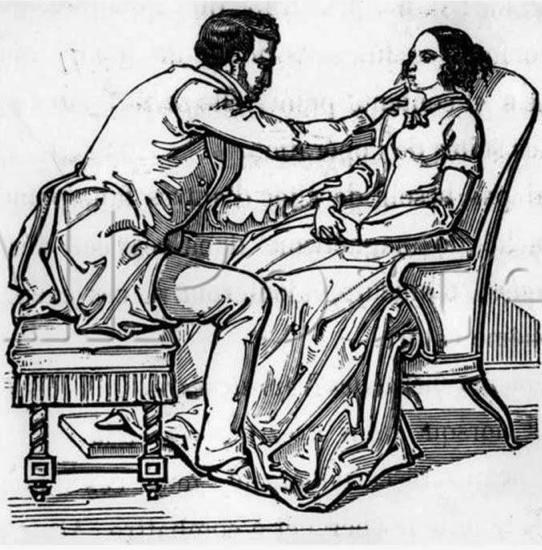 Despite potential fallout, d’Eslon took his many months of experience of animal magnetism at the hands of Anton Mesmer and published his own book Observations sur le Magnétisme Animal. Mesmer was proud and pleased to admit that, “[d’Eslon] has used all his art in presenting his report to bring out the truths that I expressed crudely in mine [Précis].” Observations made Charles d’Eslon into a larger figure in the efforts to legitimize animal magnetism. Compared to many writings of the day which were formal in style, d’Eslon’s book revealed the personality of the author: a sincere, honest physician in search of the truth. Like his mentor, he made his own rules because of his station as personal physician to the Comte d’Artois. Also like his teacher, d’Eslon took to animal magnetism because at a fundamental level it represented Truth to him. As a healer, he had no choice but to follow the Truth for itself. D’Eslon had to study and write his Observations regardless of the response from his medical colleagues and the learned ones. “Have I been wrong or right to admit highly and frankly my opinion on Animal Magnetism? In my principles, it is not the matter to question. Real honesty should not be ashamed to walk in the company of the truth.” From the beginning of his small book, the idealistic doctor had to give evidence of what his eyes had shown him. “I have seen; I see; & I say quite simply what I see and what I have seen.” D’Eslon might recognize the truth, but he also would have to defend it as he presented truth for its own sake. Like Mesmer, he imagined some day his simple honesty would be praised and rewarded. But, he soon realized that there would be a price to pay. “No prophet in his own country, the people say: No discovery of genius without persecution, say the savants.” It was simple for him to see and tell that animal magnetism manifests through the eye and the touch. The next step was to recognize the conductor of the principle. But, the hardest thing was to accept the multiplicity and wonders of magnetism in the hands of M. Mesmer. “I am so sure, he [Mesmer] said, of the existence of my principle that I may use & pass myself as the conductor of the Magnet & Electricity: I can immerse myself in one & appropriate the other & the reverse: I can feel it at a remote distance without the aid of any intermediary: I can accumulate, concentrate & transport it: I can reflect it like the mirrors to the light, communicate it, propagate & increase it by sound. I observed in the experiment the flow of matter whose subtlety penetrated all bodies without significant loss carried on. Finally, I am sure that some living bodies have such an opposite property to my principle, that its mere presence destroys all the effects of animal Magnetism. This opposite virtue is also likely to be communicated, propagated, accumulated, concentrated, transported, reflected from the mirrors, propagated by sound, etc.” It took d’Eslon some time to become totally convinced of magnetism, its discoverer and purveyor. When he did, there was much more to be done because Mesmer was a singular man, ignored customs, and was unwilling to compromise. To numerous relatively important minds in Paris, he was unrefined and even a Charlatan. D’Eslon and unnamed friends endeavored to steer Dr. Mesmer away – at least for a time – from academies and savants. They advised him to, “not attach himself to convincing the learned, in hopes that they would lend themselves to persuade the Public; but he should convince the Public to force the savants to listen.” D’Eslon went on in colorful manner saying, “I do not know if it would not be more comfortable to sink the four great rivers of France in the same bed than to gather the savants of Paris, to judge in good faith an issue of their principles.” Mesmer’s advisors predicted that he would not succeed by approaching the scholars and academics. But, the enduring German was tired of making experiments before viewers, bored with offers from manipulators, revolted by the poor receptions he commonly received, and saddened by accusations of quackery. D’Eslon told him, “Besiege the doors of our savants, as you seem to be determined, it is not our taste, & without being prophets, we believe we can predict what will happen to you.” “Was there not some resemblance between M. Mesmer & a good man who thought to make a wonderful impression one evening at the door of poor people by offering his pockets full of gold? He was taken for a thief. ‘I am nothing of the sort,’ he said for himself: ‘What else do you fear? See that you are in number, in your homes, I am alone, and I bring you the gold.’ ‘Thanks for the gold,’ they replied to him, ‘you are a thief, and this is not gold you have in your pockets. We know what we know and what you say is only to steal our rags.’ The good-man had spoken in vain. It was necessary for him to withdraw.” It seemed to d’Eslon that Mesmer was giving away his gifts, when he could have dealt with the Parisians in an entirely different manner. Had he “been greedy for money, he would have followed precisely the opposite course to his own. The man appears as sensitive to small services as to great ones, for the likely reason that gratitude is less expensive. If M. Mesmer was without this principle, he would have healed Paris of all its headaches, vague pains, small accidents. In no time his reputation would have been made, his coffers would be filled; & to these advantages, he would meet the overly troubling people who are allowed to accuse him of quackery, saying: “˜Do as much.’ But this is not his way.” Even the archnemesis, Jean-Jacques Paulet stood up for Anton Mesmer’s rectitude in a number of ways. Money and power were issues, but Mesmer set much higher sights for his work. Paulet in his Antimagnétisme wrote, “M. Mesmer has said many times that he could dupe the French all that he wished. He is extremely honest & obliging.” Mesmer and d’Eslon persisted in their paths toward Truth. D’Eslon continued to put animal magnetism into focus regarding disease, health and healing, according to M. Mesmer. 1) There is only one Nature, one life, one health; there is only one illness, one remedy, one healing. 2) Nature produces the impulse which has been given to it by the creator hand, carries in us by a thousand different channels the action of life. The free course of this action in our bodies is health. 3) When the course of these actions is stopped by occasional resistance, nature makes efforts to overcome the obstacles. These efforts we have called crises. 4) To render to Nature her true course, is the only Medicine that can exist. 5) Just as Medicine is one, the remedy is one; & all useful remedies in ordinary Medicine achieve advantageous success only by happy combinations, or by due chance, as they are used [unknowingly] by conductors of animal Magnetism. Doctor d’Eslon proceeded to review the cases of a dozen patients with illnesses in the likes of emaciation following fever, cancer, blindness due to inflammation, jaundice, paralysis of the limbs, facial paralysis, epilepsy, deafness, rheumatism, concussion, and others with conditions harder to put into modern terminology. D’Eslon endeavored to make the magnetic work understandable to his readers and palatable to the skeptics. Neither was a simple task. D’Eslon’s most poignant case was that of a young man called Picard, who following an illness and remedies (including mercury and 53 straight days of blistering), became blind. His eyes were inflamed and atrophied. His vision was so diminished that he “was not able to conduct himself.” His master was unable to properly care for the lad. But, d’Eslon had him driven by a Savoyard to be touched by M. Mesmer. After a few minutes: “the blind one became clear seeing: & in the joy of his heart, he went down, paid his Savoyard, sent him away & went back home without driver.” The next day, the boy appeared again. His eyes were sighted but they were also tearing. He wished to be presented to Dr. Mesmer and be treated again. He then made simple appeal to his benefactor. “I see, sir, he said; & it is for you that I owe it. But I know well that I am not healed. I just beg you to give me the entire grace. I am poor, in a state of want in which I offer you nothing, and am unable to render you any service. The good work will be your only reward. Nevertheless, I am still here and I hope you do not drive me away. The time I will not be near you, I will go in your attic, I will find a way to establish myself.” D’Eslon reported that Mesmer had no attic, but made accommodation for the young fellow just the same. He was fully healed and sighted in a few weeks. In another case, the patient was bordering on the state of “skin and bones,” forty-five days out with miliary fever. On Mesmer’s unexpected appearance, the weak and withered patient who had never heard of the doctor, began to recover. D’Eslon wondered how imagination could have such sudden and dramatic effects? “But, if M. Mesmer had no other secret than causing the imagination to act for health, would it not always be most wonderful? For if the Medicine of imagination was for the best, why would we not practice the Medicine of imagination?” Another patient was also a clear test for the theory of imagination. This young woman, Melle P____, had been confined to bed for five days because of unconsciousness and repeated convulsions. As the convulsions departed soon after Mesmer’s appearance, d’Eslon believed her case left “little escape, I think, for the partisans of the imagination.” However, d’Eslon freely admitted, “I do not myself know,” how animal magnetism really worked in the cases he presented. Mesmer himself was never able to put the theory of animal magnetism into words acceptable to a large portion of society. Neither his theory nor his practices suited the learned and powerful academicians. But, should that have been such a huge problem where the health and welfare of humans was concerned. “It is a fact that manna & rhubarb purge; but neither my Brethren nor I know by what mechanism they purge. The fact & experience are our only guides. It is the same with animal Magnetism: I do not know how it acts, but I know it acts.” Like rhubarb and manna, Mesmer’s agent was common and near to human beings. “When his discovery has become fact, it will amaze by its extreme simplicity.” D’Eslon claimed that it was very difficult for him to go before the public. He had to force himself to bring his ideas and experiences out in book form. He did not want to “make a scene,” but believed he had no choice under the circumstances. He closed his record much like he began. “These printed observations will be at the same time a tribute to the truth, a reason to engage honest souls to second my work, a response to those who blame me, a resource for those who agree with me. “I have never been witness of any miracle; but as this happened to me, I’m the man who had to meet it without turning back. Despite the incredulity and levity thrown out in unnecessary jokes & sarcasms covering me in ridicule; I continue to believe having responded to all, saying, I saw it.” D’Eslon was undaunted by obstacles and dead-ends in the medical and scientific communities. Inevitably, his book and the response to it in the medical community forced the issue of animal magnetism to a head. The Faculty of Medicine was stirred up by the time d’Eslon approached the Dean. Despite all past history, Mesmer had asked – even begged – Dr. d’Eslon to present a proposal to the Faculty for them to study animal magnetism. He had sent out an open letter to d’Eslon in March 1779 in which he seemed to suggest a change of tone. “If the members of the Faculty are as desirous as you seem to be of seeing the development of my theory and to propagate it, I shall expect them to please indicate the means which appear to them most appropriate for the accomplishment of this purpose”¦.” At the same time, Mesmer was intent on a supervised study of the results of his treatment of patients using Animal Magnetism. He envisioned two groups of twelve patients to be assigned by lot, one group to be treated by conventional methods the other by Animal Magnetism. Only patients with venereal diseases were to be excluded. The trial was to be overseen by the government and arranged by the Faculty. This was very new territory for 18th century medicine. Mesmer’s proposal was prescient of the methods used in medical, psychological and social experiments which ensued in the twentieth century. Van Helmont had envisaged such a randomized trial a century before, but nothing came of it. And it was certain nothing would come of Mesmer’s idea. J.J. Paulet claimed that, “He knew very well that it was an admissible proposition. The Magistrate & the Administrators of the Hospitals were instructed by the Journal de Paris, that M. Mesmer made a challenge to the Faculty & asked for twelve patients to magnetize them. The great crime of the Physicians, following him, was to not have him provide on the field their proper patients & good will to be magnetized.” D’Eslon also begged for an opportunity to present Mesmer’s proposal. This also to defend his reputation and writings to the Faculty of Medicine where he was long a member in good standing. At the same time, other Faculty members were offended that one of their own was so audacious as to publish a book on animal magnetism which wreaked of charlatanry and to suggest that French medicine was inferior to a German brand of “faith healing.” From a modern vantage point, it seems that both Mesmer and d’Eslon should have known better than to enter into the lion’s den. D’Eslon especially, for he must have been aware of numerous battles in recent years where Faculty assemblies had it out with single dissenting doctors. The latter almost always came out losing in many and traumatic ways. The Paris Faculty held monopolistic control of one degree or another, direct or indirect, on some 600 physicians, surgeons, and apothecaries. And, it meant to maintain its hold despite the upstart Royal Society of Medicine. At the same time, it was also relatively well known that the Faculty was in full decline – stuck in a bog of 18th century theories and systems, open to little innovation. The intellectual picture of the Paris Faculty of Medicine was quite well symbolized by its structural situations. It had moved in 1775 from “ruined hovels” on the Rue de la Bacherie “to dilapidated premises abandoned by the Schools of law, Rue Jean de Beauvais; its house threatened to collapse, finances declined sharply, and the number of students decreased.” (Delaunay) But, the proud Faculty persisted in “discussing ancient texts, and breeding a type of physician which belonged to days long past.” A professor was expected to lecture for an hour a day, six days a week. The first part of a lecture consisted of a dictation read by the instructor from a prepared notebook. The rest of the time was taken up by a verbal exposition of the subject. “In Paris the old medical faculty persisted like a fossil, its one thought being to stand upon the ancient ways, to maintain its traditional rights.” (Sigerist) Professors had become corrupted and lazy. Degrees, although few were awarded – less than ten doctorates per annum in Paris, were given out too easily. A. F. Fourcroy insisted that before 1789, no faculty – in the whole country – had taught a proper course of medicine. “Prolegomena stuffed with sterile definitions were the sole base [of the curricula dictated to the students from professorial notebooks]. The physical and exact sciences, which are the only source of a solid instruction, were forgotten.” So too had been hands-on experience. The importance of the latter was all but universally recognized. But, little had been done to remedy the huge hole in medical training even in Leyden and Vienna. More “clinical experience” was said to be gained by reading case histories than by observation. Real clinical instruction was practically non-existent except for a relative few in Parisian hospitals who found usually unpaid positions in hospitals as interns and externs. Students largely on their own, made the best – if really interested – of private courses, and paid handsomely for their examinations and degrees. Anatomy exams were long and involved, and assured students more knowledge of dead bodies than of living ones. Annual dissertations [generally called disputations] were based on notes on theory collected and rehearsed by the faculty. They served as a platforms for debate which tested stamina and Latin prowess more than knowledge in anatomy and physiology, hygiene, symptomatology, pathology, therapeutics, as well as botany, surgery and pharmacy which were added later in the century. Quality tuition was available from anatomists, chemists and botanists at the College Royal and the Garden of the King [Jardin du Roi] for added fees. It was said that no one ever failed an examination. Prospective students were rarely rejected for intellectual reasons, but rather for moral or political or financial or religious ones. If a student followed the rules, his right of passage by way of bachelor, licentiate, doctor, and regent was secure. Each step was expensive if not educational, requiring four to six years. The passage was generally restricted to nobles, the wealthy, and sons of physicians. A doctorate in Paris cost on the order of 7000 livres plus expenses for celebrations. A huge sum in that time, when the average artisan was fortunate to bring home 250 livres in a year. Many young doctors finished their program – as in other cities and countries – and were launched into the world before the age of twenty-one. Vicq d’Azyr was another reformer in the mold of Fourcroy. He had struggled with Mesmer via the mails over the “certificates” which the latter wished to present to the Royal Society of Medicine early in the German’s time in Paris. D’Azyr eventually took up the cudgel for improving medical education (sounding much like Mesmer) when he made a presentation to the National Assembly in 1790. He deplored the faculty at Paris which existed much in the same fashion as others around France: “She has seen that public education in medicine is almost everywhere devious or nil, that the bodies responsible for conferring the degrees are too many for them to be able to maintain this vigor without which they must necessarily wither; that the manner in which professors are admitted to the concourse and the way in which applicants are received into the Schools promote everywhere, if not ignorance, at least mediocrity; that in the distribution of the studies the students are obliged to formalities and hindered by barriers that have no useful purpose. She has seen that the most essential parts of medical education are absolutely forgotten and that the hospitals are in no part organized to render facile instruction and to serve the advancement of the art the facilities that one destines for the relief of humanity. “What can be expected, in fact, from a few years of study which are passed in dictation or reading of medical texts only formed of definitions and of sterile divisions … where there is not said a word of the public functions of the physician, where no one yet has professed his art at the bedside of the sick, and where one is finally released without having learned anything of what a doctor should know?” The Encyclopedist Diderot woefully depicted the general state of affairs when a new Paris-trained physician started into practice never having had an opportunity to practice: “Therefore [a young physician] makes his first essays [at the art] on us, and only becomes skilful by dint of assassination.” D’Eslon persisted with his request even though Le Vacher de la Feutrie, the Dean of the Faculty, tried to stall him. The Dean was personally hostile to magnetism, but he did not want to be so with Charles d’Eslon whom he called friend. At the least, the Dean wanted the two sides of the issue to be presented on separate occasions. He was quite aware that sparks would fly if d’Eslon and anti-magnetism forces took the floor on the same occasion. De la Feutrie delayed the proceeding as long as possible, hoping that it would go away. It wouldn’t, but the Dean did. The clash on 18th September 1780 eventually showed Le Vacher de la Feutrie unwilling to continue at the head of the “undisciplined” Faculty. He resigned soon thereafter. Charles d’Eslon would not back down. Nor would the speaker chosen to oppose, if not attack, him at the fateful meeting. Mesmer described Roussel de Vauzesmes as “young Doctor of recent license: he is, in every sense of the term, a pupil whose education is not over, even if it has never been seriously begun.” De Vauzesmes was recruited to make the case for others who were unwilling to take their own stands against their medical adversaries and animal magnetism. “He was researched, caressed, flattered, consulted, admitted to the assembly: what glory!” De Vauzesmes was first to take the podium. He came out swinging and made rabid indictments of both Mesmer and d’Eslon. Mesmer for his incomprehensible theory and quackery, and d’Eslon for supporting the alien. De Vauzesmes called Mesmer a charlatan and German juggler. He suggested that Mesmer’s methods had been repudiated repeatedly even while the two had been out peddling each other’s books. D’Eslon associated with dubious characters and charlatans, Mesmer was not the first. “He comports himself in a manner little conforming to the dignity of his state, as favoring charlatanism; in consequence like insulting all the scholarly companies and especially this Faculty; finally as abjuring absolutely the doctrine of the Schools, as announcing contrary principle to healthy medicine and giving us in order to support and confirm these false principles, the observations of impossible cures.” De Vauzesmes continued to thrash at Mesmer with petty as well as substantive attacks. He dug in deeper saying, “According to Dr. Leroux, [Mesmer] managed to cure half the ills afflicting humanity. Finally, Dr. d’Eslon added to that, boldly telling the public that [Mesmer] healed all diseases, even those that are incurable.” The tenor of the new doctor’s presentation continued to be disrespectful and seemed out of order to others besides d’Eslon. The Dean, presiding at the session, made repeated efforts to restrain the aggressive prosecutor. He believed d’Eslon deserved better than that represented in the conduct of de Vauzesmes. When Dr. de Vauzesmes persisted, the Dean instructed him under Faculty regulations to reduce his diatribe to a written summary. Thereafter, de Vauzesmes produced his own Memoir in short order and Mesmer responded to it in detail in the latter pages of his Précis. The young physician recalled Mesmer’s trials in Vienna, using only the parts of the story which suited his exposition. He provided letters from Vienna to support his case, yet some seemed to bolster as much as detract from Mesmer’s side of the story. One written to Father Hell dated December 1777 puts Mesmer’s days in Vienna in some perspective. The friend of Hell took Mesmer to task for “The reputation that he has made in this country, is not scarcely better than the very Reverend Curé Gassner, whom you have seen. While one claims to work miracles by a supernatural virtue, the other uses a remedy that Nature has put in his hands, yet he does not know any better the effects than the cause which produces them.” The correspondent went on to observe that Mesmer was confident in his words, especially to his “imaginative” patients. He veiled his hands-on methods with dazzling and sometimes unintelligible language which was passed on to newspapers and journals to promote his dubious reputation. Nonetheless, the writer concluded his note by saying, “Take this, my dear friend, you have to believe the mark of the person who has the gift of health so much to heart. In his place, I would not expose myself to the unnecessary expense of a long journey [to Paris], and the danger of chance. The reputation of M. Mesmer made a lot of noise outside [Vienna], but in Vienna we talk so low that we cannot hear what is spoken.” De Vauzesmes extracted another letter from Dr. Volter, Director of the Bavarian Royal Academy of Sciences. Volter recognized that Mesmer was able to shake the nervous systems of patients, but thought such was eventually to their detriment. “This is a very bold man, like all the charlatans, to use the names of those people at Vienna & Munich he claims to have cured; including M. Oesterwald, who strongly believed in [Mesmer’s] truth following his treatment, but in a short time became sicker than ever, and whose forces became more prostrated every day, until he finally gave out.” Mesmer could not but respond to Volter’s review of his work. “As to M. Oesterwald, I do not know how he has used his health since I returned [from Bavaria]. He married since: I assured myself that he would die on leaving table, or from indigestion, or from a stroke. I am sorry for not having made him immortal.” The summary of de Vauzesmes eventually came up to current time in France for which he included a selective laundry list of complaints. His tirade reinforced the notion that Parisian physicians above all were concerned with “dress and address.” “You see clearly, gentlemen, that M. Mesmer mocked the Academy of Sciences, the Royal Society, and that he also would wish to impose on you, if it were possible, and compromise you.” Eventually, de Vauzesmes reviewed a number of the cases discussed in d’Eslon’s Observations without noting that all his information was based on hearsay since he had not witnessed a single case. Nonetheless, de Vauzesmes consistently found fault and falsehoods, mistakes and mummery in their patient care. Not once did he point out a positive result, a patient relieved, or a cure established. Even quacks, like orthodox practitioners, do sometimes have successes. De Vauzesmes found incredible the story of the child who was feverish, emaciated and ill for 45 days but revived in a little more than an hour. C’est impossible. “How is it possible that a child in a state of doldrums & dying, whatever the means employed for relief, to be able in five quarters of hours to experience a change that allows him to eat bread, a crayfish, & drink champagne?… This treatment should be referred to the rank of those that are impossible.” Mesmer responded saying that he might add several similar examples, “but suffice it to know that in general my patients, whatever their state was one or two hours beforehand, they left me in the morning to go to dinner, and the evening for supper…. This nutritive Medicine seems a fable in the eyes of Doctors accustomed to kill their patients by hunger, when they can not come to the end otherwise. However, they ought to reflect that nutrition is an urgent need of nature, while the compulsory fast is only a system outside of nature.” De Vauzesmes remarked on another seemingly impossible case in a brief paragraph which tells the story while explaining the impossible part. “OBSERVATION: Paralysis with atrophy of the thigh and leg. The cure of paralysis is without doubt the most surprising. There was neither natural heat nor movement in the thigh: the flesh was shriveled & dried: bones were shorter & more slender than those of the other side of the body; & this patient had been declared incurable by the surgery schools. Well! d’Eslon says flesh returned: the bones have grown: the movements are free; & that which is most singular to the left, once the shortest, is at present the longest. The observer must admit the fact is incomprehensible. I am entirely of his opinion.” De Vauzesmes wanted the patient re-examined by the Academy of Surgery. The prosecuting doctor went on to discount other cures including that of Picard. “M. Mesmer, whatever was his agent, could not restore the organ [eyes] in minutes. So there was in this observation a miscalculation…. It is not true that he had atrophied eyes.” The young physician chose to give credit for the lad’s recovery to a number of other doctors who had seen the patient previously. The most significant and highly disputed case was that of M. Busson, a member of the Faculty of Medicine and First Physician to the Comtesse d’Artois. Busson suffered with a huge nasal polyp the roots of which were pushing his right eye from its orbit. He had been examined numerous times by the Faculty’s best: his colleagues Ferrand, Grandjean, de Horne, Louis, Moreau. The physicians temporized being unable to decide if his lesion was cancerous or not. They debated to operate or not, to apply caustics or do nothing. They crossed their fingers and hoped the tumor would melt away as the polyp suppurated. The polyp had been expanding and discharging blood for six months when Busson consulted Mesmer. Doctor Mesmer quickly took charge and became his personal physician. After his first session of magnetism, Busson said he felt better than he had for a long time. The nasal discharge soon ceased and the polyp detached. The eye returned to its normal position. Busson asked permission of the Comte d’Artois to continue treatments with Mesmer and was so granted. Mesmer had to tell Busson, because of the nature of his illness, he would have to lodge near Mesmer so that he might dedicate “all my moments to him that I might steal away from my ordinary occupations.” The arrangement was agreed. Sadly, Busson’s disease spread to his bones. Mesmer continued at Busson’s side, calmed his pains, and stood as his friend as well as doctor to the last. The treatment of Busson was a failure in de Vauzesmes’s eyes. (Mesmer had not made Busson immortal.) But then according to the prosecuting doctor, so were all other treatments and cures performed by Mesmer and d’Eslon in the name of animal magnetism. The original mesmerists could not succeed however they proceeded. The young physician, and the majority of the Faculty of Medicine, were unwilling to listen or look. Yet despite his venom, de Vauzesmes’s summary did present a number of worthy questions and seeming contradictions regarding Mesmer’s stands. He wanted to understand: 1) Why Dr. Mesmer wished to bestow his discovery on the Faculty of Paris rather than that of Vienna where he was once a member. Why did he desire to honor France rather than Austria? 2) How he could repudiate and turn away investigators because of their supposed anti-magnetic power. Was that not a means of evasion rather than advancing verification? 3) Dr. Mesmer’s desire for a Commission to review his treatments. At the same time, he wanted to keep his secret and reject judges not suitable to him. How could animal magnetism ever be tested? 4) How animal magnetism can be considered painless. Patients were told they would not suffer. But, did not all manner of symptoms and distress arise during supposed healing crises? 5) Mesmer said there is only one remedy which is animal magnetism. But, he also used bleeding, baths, emetics, purgatives, mineral waters. Are they also not remedies? D’Eslon presented a witty response to this provocative question. “Doctor objected in my presence to M. Mesmer that he could well be wrong to attribute to animal Magnetism, the effects felt by patients, since he also employed remedies like cream of tartar known for its actions.” Mesmer answered vigorously, “That is true, sir; I also ordered her chicken & salad. You now have my secret, you are permitted to use it. I do not doubt that you will do wonders…” In the course of the whole September assembly, no one rose in defense or support of d’Eslon other than the Dean of the Faculty. Most particularly, not a word before, during or after the meeting came from Bertrand, Malloet, and Sollier, the physicians who spent seven months watching Mesmer and d’Eslon touch, influence and sometimes heal. Taking his turn to speak, Dr. d’Eslon stood his ground repeating that animal magnetism was one of the most important scientific contributions of the age. De Vauzesmes’s insults and ridicule provided neither arguments nor useful information. D’Eslon beseeched the Faculty to read what he had written and ponder the fundamentals of his long and studied investigation. Animal magnetism was a truth which needed their attention and an honest hearing. M. d’Eslon called for an enquiry by the Faculty as requested by Dr. Mesmer which would compare patients treated by standard and magnetic methods. After brief deliberations, the Faculty turned d’Eslon down. They went much further with a four-point conclusion. Docteur-Régent d’Eslon was admonished to be more circumspect in the future. His voting rights were suspended for a year. He was told to disavow his Observations in that time period. To top it all, the Faculty again rejected Mesmer’s propositions suggesting they would never consent to investigate Animal Magnetism. Dr. d’Eslon’s future was in jeopardy. Mesmer appeared out of range of the Faculty because he had been qualified in Vienna. Neither his credentials from Vienna nor his right to practice medicine in Paris were ever challenged. Regardless, the public paid little attention to d’Eslon’s struggle with the Faculty as they were little affected by the pronouncement. Besides, the people had progressively lost respect for the Faculty and similar institutions since the time of Molière. Many laughed because they had compared the extraordinary results of magnetism to the remedies of ordinary medicine. They found the latter to range from powerless to dangerous. D’Eslon carried the issue to the King’s physician who was agreeable to the idea of creating a commission. Efforts were made in that direction, but the commission was eventually abandoned when dispute arose over details of the proposal. Failure upon failure with Savants and Practitioners increased Mesmer’s distress at the state of medicine, Parisian as well as Viennese. He simply decided that, “They are afraid.” The fear spilled over time and again into jokes on Mesmer and d’Eslon among idlers in the streets and salons of the French capital. Sadly, the jokes turned to out to be on the Parisian public. Early in 1781, Mesmer was fed up with the whole situation. He felt himself abused and disrespected, and let it be known through one of his patients, the Duchesse de Chaulnes, that he was intending to soon leave the country. By March, a “person of rank” stepped forward (at the Queen’s urging) and opened negotiations with Mesmer on behalf of the government. Marie Antoinette interceded even though she had lost her mother, Empress Maria-Theresia, the previous November. Etiquette required her to remove herself from public affairs for months during her bereavement. Eventually, Minister of State Jean-Frédéric Phélypeaux, Comte de Maurepas took charge. Known as a master of compromise and prudence, he told Mesmer and d’Eslon in March 1781 that the King was prepared to make generous offers. The government would invest in animal magnetism despite the Faculty of Medicine. But with a stipulation that five commissioners examine patients and processes. On favorable report, a large house and grounds for doctor and patients along with annual stipend of 20,000 francs were to be offered to the Doctor for treating patients and teaching physicians. Mesmer would also be required to stay in France at the King’s pleasure. Anton signed the contract reluctantly. Two weeks later, the Comte de Maurepas appeared with some amendments. Mesmer’s stipend would stay the same. But, Mesmer would have to accept a sum of 10,000 francs for housing and hospital arrangements. More importantly, the whole agreement would be contingent on Mesmer’s teaching students rather than being inspected by commissioners. The physician students were to be selected by the government and expected to “judge” the validity of Mesmer’s training and healing system. The Doctor rendered a resounding rejection. Mesmer returned to his standard position that he could never convince physicians or academics that his invisible, intangible, ubiquitous fluid existed. Since it could not be weighed or measured, seen or contained. Recognition could only come through effects and experience. Only by results. Thus, he wrote, “My intentions when I came to France were not to make my fortune but to secure for my discovery the unqualified approval of the most scientific men of this age. And I will accept no reward so long as I have not obtained this approval; for fame, and the glory of having discovered the most important truth for the benefit of humanity, are dearer to me than riches”¦. It is contradictory and impossible that I should be judged by my pupils.” As on many occasions, Anton Mesmer stood firmly on his principles, truths, and discoveries. At the same time, he must have appeared unbending to the King and his minister. Surely, he was thought to be arrogant and inflexible. After all, Kings were not trained to bow to any man however many talents and gifts he had to offer. An impasse followed and Mesmer had to consider other possibilities. The King was not going to compromise further to suit his requests. But, Mesmer was not done. That “divine German” had gotten through once to the King via Marie Antoinette’s ladies-in-waiting. He was their physician and they were his patients. The Queen was interested and partial to his work. All the more, it was said that the whole of cultured Paris was supporting Mesmer. He turned again to the Queen in a long beseeching letter. On the one hand, he wanted to thank her. On the other, his pride seemed to outrun his place as a foreign physician on the field of state in Paris.  Marie Antoinette, Queen of France Mesmer’s letter was presented to his Austrian kinswoman through an intermediary in her entourage, but also was circulated beyond the court. Mesmer claimed he had given up hope of arrangement with the French Government, and merely asked Her Majesty to accept his respectful plea. “I insistently beg your Majesty to consider that this offer should be guarded from any pretentious interpretation. It is to your majesty that I have the honor to make it; but independent of all graces, all favors, any expectation other than for joy, immune by the power of Your Majesty, the tranquility & the security which have been accorded me in her States since I made my residence here. It is finally MADAME, by declaring to your majesty that I renounce all hope of arrangement with the French Government, that I beg her to accept the most humble testimony, of the most respectful, and the most disinterested of deference.” Money should be a secondary consideration in any negotiations. It was the happiness of the Peoples which was much more important than four or five hundred thousand francs. Mesmer had received daily monetary offers for three years while going through large sums of his own funds. He would continue to treat patients (some of them close to the Queen) for six more months. Yet, the betterment of all humanity weighed more than caring for a score or so patients. He had to move on to more appreciative territory. Even as he already had done because of intrigues in Austria, the Queen’s homeland. He would look for a Government which would not take lightly the introduction of a great truth into the world. Public opinion eventually would decide to do Mesmer justice. “If it is not in my lifetime, it will honor my grave to its regrets.” He set a departure date for 18 September 1781, one year from the date when the Faculty of Medicine of Paris dismissed d’Eslon’s presentation and Mesmer’s proposal. Numerous parts of Mesmer’s letter have caused many writers to wonder how he managed to survive the publication of such an appeal. He had written almost as if he himself were royalty, equal with the Queen and her brother, Emperor of Austria, rather than a commoner of notorious but questioned acclaim. Mesmer was on foreign soil at the pleasure of the King, not the other way around. Twenty years earlier, his impudent writing would have put him in the Bastille by simple warrant of imprisonment. Fortunate for him, letters of cachet were becoming a thing of the past. Mesmer’s eyes eventually passed from the Queen to other issues. Money was supposedly never one of them. Or, so it seemed. Mesmer attracted it like patients, without much effort. Still, he always seemed to keep a close eye on the finances of his operations. He was most keen to have the leading scientists make honest and thorough study of his cures – according to his own lights. Secondarily, he wished to obtain a recognized position in France or elsewhere which would leave him free to pursue his investigations instead of disputing with the medical orthodoxy and fending off the doubting press. The Doctor also needed to address issues arising from his early magnetic work in Paris when he became known to some as a magician doing miracles, and to others as a charlatan blind-siding the public. The baquet had become a major point of contention, scandalous in some critics’ minds. Morality was said to be outraged by the imagined activities in the salle de crise. With all the blunt complaints and scurrilous innuendos, Mesmer was intent to return to treating patients separately. Furthermore, owing to demand for his attentions, trained magnetists were needed to fill in for the Doctor. The Doctor stood on his principles and the sure knowledge of experience. Not all Mesmer’s supporters accepted his position, viewing it as unbending and unworkable. Thus, Charles d’Eslon had taken on Mesmer’s earlier passion for a Commission and decided to separate himself from Mesmer, for the first but not the last time. “You are discrediting Animal Magnetism and all it stands for. Everybody must think the whole thing is an imposture if you refuse to allow an investigation. Though you can claim to have discovered the principle, I too have claims. I have devoted my life to it, I have staked my reputation and my entire future on it. I will go to the Faculty and offer to give a demonstration before the commissioners – I, at least, am not afraid!” While d’Eslon continued to carry the torch, Mesmer knew what would come of such an endeavor. The invisible principle of animal magnetism was bound to fall short and be discredited under the scientific conditions of the period. Yet, a Commission seemed fated to occur. Only the date and details were yet to be determined. In August 1781, Mesmer traveled to Spa in eastern Belgium where the rich relaxed and tended to ailments which regular medics could not relieve with their drugs and plasters. During his interlude at Spa, the Doctor wrote his Précis. He began with a brief summary of the work in Vienna. Thereafter, the book attended most particularly to his Relations avec l’Academie des Sciences de Paris, la Société Royale de Médecine de Paris, & la Faculté de Médecine de Paris. Much of the latter part of his narrative was concerned with the fateful meeting on 18 September 1780 when Charles d’Eslon faced off with Roussel de Vauzesmes. Mesmer interspersed his narrative with cases and stories which were meant to bring the method of animal magnetism into the perspective of human experience, suffering and healing. “Animal Magnetism must be considered in my hands as an artificial sixth sense. The senses neither define nor explain themselves: they just sense. It is in vain to attempt to explain to a blind man the origin of the theory of colors. It is necessary to make him see; that is to say to sense. It is the same with Animal Magnetism. It must first be transmitted through sense. Sense alone can make intelligible the theory.” Despite his seemingly vain discussion of senses, Mesmer persisted in a wide range of efforts to get his written, spoken and announced theory legitimized. Anton Mesmer craved the recognition of the scientific community. But, his writings on animal magnetism suggest the relative impossibility of that happening. At least in his time. He discovered the sixth sense, knew it and taught the use of it. At the same instant, Mesmer was quite aware how tenuous and elusive it was. His methods were based on the essence of natural forces, but essence like the soul is difficult for all but a tiny few to grasp. Was it conceivable that the hard-headed scientific and academic community would ever come to grips with it? Mesmer was drawn back to Paris before long from Spa when he heard that d’Eslon was taking advantage of his absence. Melchior Grimm wrote freely of the situation: “His disciple, d’Eslon, thought he should console Paris for the loss of his master by setting up an establishment for Mesmerian treatment. A beguiling personality, still possessing the advantages of youth and pleasing demeanor, had brought d’Eslon the protection of some women of letters of the second rank. They undertook to create for their protégé a reputation in animal magnetism…. Mesmer rushed back to Paris, and his first care, as one might expect, was to accuse of infidelity and ignorance a pupil who, instructed with difficulty in his doctrine and his principles, dared to magnetize without his approval and on his own account. He asked the public by way of the journals to ignore the same man whom six months before he had praised for his profound knowledge and practical skill in animal magnetism.” 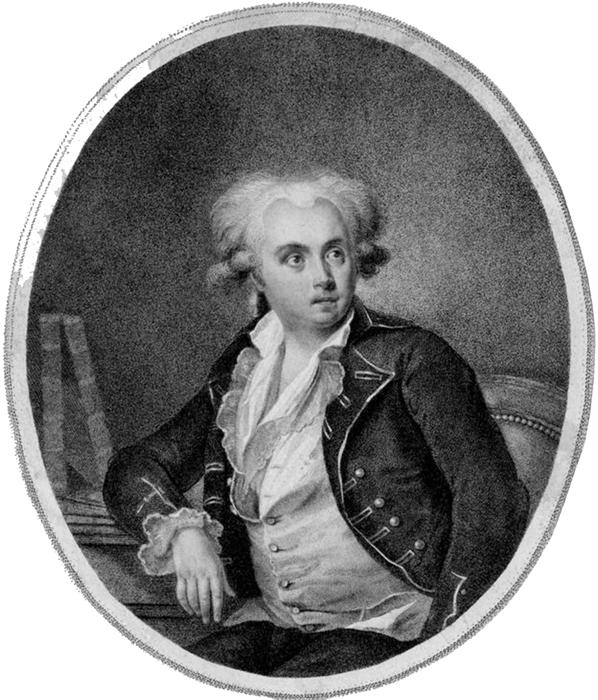 Nicolas Bergasse (1750-1832) Anton Mesmer did not pack his bags, as he had threatened in his letter to the Queen, to go looking for another government to underwrite his humanitarian work. After confronting d’Eslon, the two worked together for another year while he decided to stay close to the French capital because of two of his patients. Nicolas Bergasse, Parisian lawyer, and Guillaume Kornmann, banker from Strasbourg, became increasingly important in Mesmer’s hopes to spread his discovery to the world. Bergasse and Kornmann prepared themselves to do whatever was necessary to keep the Doctor in Paris. Mesmer traveled back and forth from Paris to Spa to tend patients at a clinic he eventually established in a house offered him by the Marquise de Fleury. At the same time, Mesmer and d’Eslon cycled through reconciliations, collaborations and separations. The patronage of d’Eslon’s patients expanded despite the proclamations of the Faculty of Medicine. And, Mesmer’s irritations with his foremost student waxed and waned over time. According to Grimm, “The reunion could not last long: it was impossible to reunite and persuade to live in peace the women who had worked together to build d’Eslon’s reputation and Mesmer’s; neither side could excuse the pretensions of the other. The Mesmerians could only be condescending in allowing the Deslonians the honor of sharing Mesmer’s treatment with them. The Deslonians reserved for d’Eslon, whom they considered their property, and who remained the idol of their egotism, both their preference and a bias that made them reject all interest except those of d’Eslon. The masters rejoined one another in vain. Between the different sects there always existed a feeling of acrimony to which there soon succeeded all kinds of reproaches, and which finally ended in scenes as bitter as they were scandalous. They forced Mesmer and d’Eslon to separate again, and again the journals were filled with recriminations of the master and the disciple.” They parted company again in July 1782. Mesmer pushed Bergasse to put into operation a plan for subscriptions. Thence, an appeal went out to the well-heeled “in order to protect a shamefully persecuted man from the fate prepared for him by the blind hatred of his enemies.” The process was initiated to form the first Lodge of Harmony with the mission to carry forward Mesmer’s discovery and works. The Bergasse-Kornmann plan included three parts: a charter subscription to be opened for 100 members to join on payment of dues at 100 louis apiece: that sum belonging to Mesmer; Mesmer to teach the members how to control and apply animal magnetism once subscriptions were filled; diplomas to be granted qualified pupils allowing them to set up as independent practitioners. In 1782 as the anniversary of his condemnation neared, d’Eslon pressed once again with the Faculty of Medicine through its new Dean. Writing to the Dean Philip, d’Eslon fought back against the insults which had been hurled at him. All manner of doctors of Paris had involved themselves with foreigners and healers thus compromising themselves in the eyes of the Faculty, but no censure had been made. d’Eslon believed himself singled out because of his association with Anton Mesmer. “They strike me for having consulted with a physician not approved by the Faculty, but what doctor of the School is innocent of this crime? Who then would refuse to see a patient with Louis, Andouille or La Martiniere? With Tissot of Lausanne, that one comes to welcome with open arms. Who then would throw at me the first stone? “It will not be you, Monsieur the dean, you are too gallant a man; I will enter one day as my habit at the house of M. Mesmer and find him entertaining with you, you pressing him strongly to be burdened with a patient whom he treated for some time at your solicitation. Then, Monsieur the dean, you there duly affected and convinced to have seen the charlatan, to have consulted, and to have solicited him, and to have confided in him the days with a mother of family, in a word to have committed the same fault as I. You would then be radiated, s.v.p., then as I, M. the dean. “Have I prescribed a secret remedy? But it was only held for you to investigate it; moreover the Faculty has nothing to envy me on this point of the view: M. de l’Epine has he not propagated, ordered the remedy of the charlatan Gamet, Majaut the oils of Damner, Bouvart the Bellet specific, Morand the Nicole tea, Granclas the Royer specific, Desessartz the powder of Fuller? And Dumangin opens to publicity the columns of his journal, as much as Bacher pockets by a thousand ecus of income for his fruitful pills. Who then called after the dying Maurepas the charlatan Gondran with his drops for the gout? de Lassone. Who met the charlatan Seiffer at the bedside of Mme de Mazarin? Thierry, Majaut with d’Eslon. “Who cared for the Comte d’Herouville with Mesmer and d’Eslon? Gouriez de la Motte. And Borie had consulted in form at Creteil, house of Mesmer, with d’Eslon and Tenon the surgeon. And Maloet and Sollier, who said nothing from fear to compromise themselves, had they not studied at the house of Mesmer, during seven months, like d’Eslon? To radiate, all!” (Delaunay) Setting himself aside, d’Eslon challenged Dean Philip to give to the matter a definitive solution by the requirements of law. Satisfaction must be given to him. On 20 August 1782, the Faculty came down with a third unanimous and theoretically final condemnation of d’Eslon. He was, for two years, deprived of the honors of the regency, of the right of suffrage, of the doctoral monies, and condemned to a definitive radiation at the end of this delay if he had not come to repentance. D’Eslon could have avoided “radiation” from the Faculty by merely “signing on the dotted line.” But, that would have require him, “after saying that he saw, to declare he saw nothing; he must publish that he wished to deceive, that the facts he reported are false; & when he had established a genuine way that he is a rogue, the Faculty will hasten to receive him as their own, and maintain him in all the honors by which she threatens to strip him.” He refused, continued to defend magnetism, and appealed to Parlement (justice court) in his name alone. At the same time, d’Eslon stood as his own man, no longer student and collaborator of Anton Mesmer. Dr. d’Eslon’s position appeared to mark a turning point in French magnetism as he gradually turned away from Mesmer’s strict doctrine. At the end of Spa’s 1782 season, the serious work of building a new Society began. By then, Mesmer was bothered and impatient. He had Bergasse help him compose a letter to the dean of the Faculty of Medicine disavowing d’Eslon “who falsely declared himself possessor of secrets of magnetism.” “D’Eslon remained alone at the breach to receive the blows of the Faculty. His pain and his surprise were without limits when Mesmer wrote from Aix-la-Chapelle, 4 October 1782, to the dean Philip, declaring that d’Eslon never had knowledge of his secrets, ignored all of magnetism, and that it was imprudent of the part of the Faculty to condemn a doctrine on the words of a disciple so zealous as ignorant. “Why this treason? d’Eslon had declared himself in front of the Faculty, 20 September, possessor of the secret of Mesmer, and Mesmer did not like the doctrinal competition. He further did not like the professional competition; but, d’Eslon was handsome, young and gallant; in the absence of the Master, he put himself to magnetize on his account, the curious among the women of letters; his reputation extended to the house of friends of women of letters and in the world of the gazettes; he passed for a second Mesmer, and came soon to the head of twenty serious clients, others said sixty, who, for ten louis per month, came to relieve their vapors at force of convulsions. The noise of his successes went as far as Spa: Mesmer became jealous, he returned.” (Delaunay) Bergasse and Kornmann seemed to pick up where Charles d’Eslon left off. The two had been and continued to be patients of Dr. Mesmer for some time. Magnetism eased Bergasse’s abdominal complaints (and quite likely nervous discomforts) and healed Kornmann’s son of an eye condition. The Doctor then went on to ease the father of his own ills brought on when his wife deserted him. Then, the duo came forward to bring opportunity and honor and fortune to the German physician. So, Nicolas Bergasse repeated many times in letters, pamphlets and articles. Mesmer found loyal followers along the way. And, Attorney Bergasse was especially dedicated “to ensure, as far as it depended on me, the fortune and glory of Dr. Mesmer in placing him in a situation where he could, without inconvenience to himself, make public his discovery.” Bergasse told in the coming times that he sacrificed himself risking his property, reputation and freedom, while Mesmer offended him deeply and abandoned him to “the most odious ingratitude.” His writings testify to a fawning disciple, trying to be better than his master and taking credit wherever possible for “many ideas that were not his, many ideas of which the largest number were mine,” and umbrage for perceived or actual slights, time and again. “My notebooks written, I developed the Doctrine of Magnetism with enough success to make myself understood, as much by former students of Dr. Mesmer, as by new ones who flocked from everywhere to receive his principles. Thanks to my care, Dr. Mesmer preserved or collected in two courses that I gave myself the trouble to do more than two hundred twenty thousand livres. Notice that Dr. Mesmer attended my courses, but was not there to speak.” “Without naming Dr. Mesmer, I have overturned all the basics of his system, and I have raised on the ruins of this system an edifice, I believe, much larger & more solidly built than the one his first students paid so dearly of its materials. It seems that one has been struck with the wholeness, with the novelty & with the boldness of my ideas, and they have been generally preferred to those of Dr. Mesmer.” With the same pen, he admitted to being sick since childhood and being unable to work at any occupation for five years. In the course of events, his sensitivity became “active, impatient, even proud.” Thus, the neurotic Bergasse found himself in a difficult situation. He was an indefatigable and devoted organizer and developer for the Master of Magnetism. But, he inevitably was disturbed by the benefactor who had relieved his suffering when all other remedies failed. His anger resurrected his symptoms which drew him back again and again to the assuaging hands of Doctor Mesmer. Relieved of their ailments, lawyer and banker proceeded to form a joint stock company for a teaching academy intended to rival and surpass the royal ones. Bergasse and Kornmann got Mesmer attention, subscribers, and money. The Society of Harmony which they developed was to be open to 100 members, paying 100 louis each – 2400 livres. A very substantial sum of money for the times. The contracts being solidified in March 1783, forty-eight members including four doctors of medicine were subscribed in relatively short order. All would receive full instructions and diplomas with rights to practice where they wished. Students were not to divulge the “secrets” of their training given by Dr. Mesmer. The intention was for all – rich and poor – to profit from Mesmer’s method of healing and to move the whole of the French society toward a state of “harmony.” Within twelve months, the membership was over-subscribed as 340,000 livres were collected in Paris alone. Societies numbering nearly forty were created across France in cities and towns as well as in the French provinces and colonies. The societies in collective drew subscriptions to the tune of 500,000 livres to establish venues for magnetic healing. By the time membership had reached a total of 125, the society included 6 priests, 2 magistrates, 25 physicians, 9 surgeons, 27 military officers, 4 lawyers, 5 merchants, a score of government officials. By title there were 2 dukes, 3 barons, 3 viscounts, 11 counts, 11 marquises and 3 chevaliers. Six members were stationed in Santo Domingo which then was busy with the slave trade. Provincial societies appeared in most of the major cities of France and numbers of smaller ones. The roster of members became a veritable Who’s Who of 18th century France: clerics Dom Gentil and Père Gerard the superior general of the Charité, the Marquis de Puységur and his brothers the Comtes Maxime and Antoine, the Vicomte de Noailles, the Marquis de Chastellux who soldiered in America without using his title, the Comte de Choiseul who directed the Paris Museum, Adrien Duport who was Member of Parlement, the Duc de Rochefoucauld, the Duc de Lauzun, the Duc de Coigny, Baron de Talleyrand, Saint-Martin, and physicians Cabanis and Berthollet. Some of these men, most notably the Puységur brothers, became accomplished magnetizers in their own rights and provinces. Others carried animal magnetism to the veterinary schools in Paris and Lyons. Together, the students of Mesmer were able to demonstrate the beneficial influence of magnetism on children and the elderly, the blind and unconscious, and on animals of diverse species. In the midst of Mesmer’s students in the Society of Harmony were others with names which resounded beyond the confines of France and its colonies. Some still remain fixed in American minds: William Temple Franklin, Benjamin’s grandson, and especially Gilbert du Motier, Marquis de Lafayette, the hero of the American Revolution. Lafayette was for some time quite involved and wrote excitedly to his beloved friend and mentor George Washington: 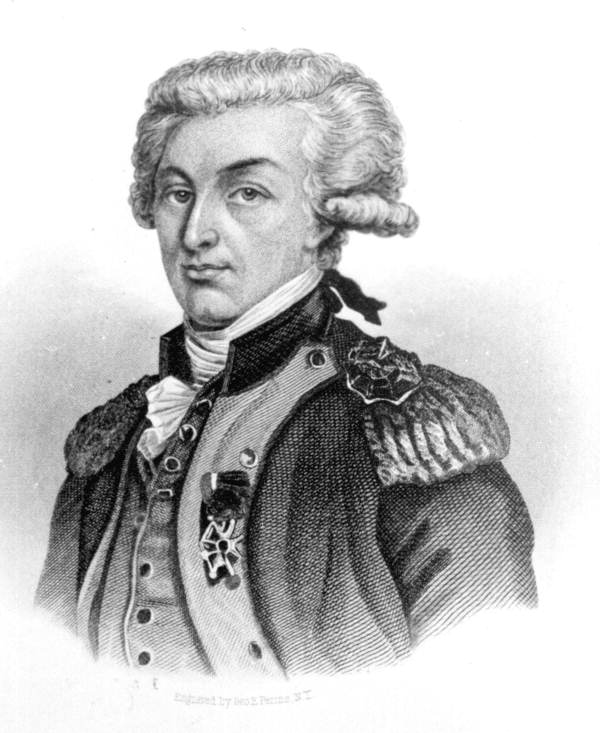 Marquis de Lafayette “German doctor named Mesmer having made the great discovery of animal magnetism, has trained some pupils, among whom your humble servant is one of his most enthusiastic pupils ““ – I know as much about it as any sorcerer ever did…. Before leaving I will obtain permission to let you into Mesmer’s secret, which, you can count on it, is a great, philosophical discovery.” Anton Mesmer sent his own letter to General Washington in 1784: “Sir, The Marquis La Fayette proposes to make known in the territory of the United States a discovery of much importance to mankind. Being the Author of the discovery, to make it as diffusive as possible, I have formed a Society, whose only business it will be to derive from it all the expected advantages. It has been the desire of the Society, as well as mine, that the Marquis should communicate it to you. It appeared to us, that the man who merited most his fellowmen should be interested in the fate of every revolution which has for its object the good of humanity, I am, with the admiration and respect that your virtues have ever inspired me with …” Lafayette’s intentions to found societies of harmony in the new United States did not proceed far in the midst of other post-Revolutionary activity. One, but surely not the only deterrent, was Thomas Jefferson who intervened by sending anti-mesmerist pamphlets to influential people in America. The young general’s plans failed to develop in any of the states. He was able to lecture notably at the American Philosophical Society in Philadelphia and to do researches in the New World. Thus the Marquis found evidence through Shaker rituals and Indian tribal dances that mesmerism had wider influence than many Europeans dared imagine. Eventually, Washington responded to the interests of the European mesmerist. He wrote Mesmer late in 1784, saying, “Sir: The Marquis de la Fayette did me the honor of presenting to me your favor of the 16th of June; and of entering into some explanation of the powers of Magnetism, the discovery of which, if it should prove as extensively beneficial as it is said, must be fortunate indeed for Mankind, and redound very highly to the honor of that Genius to whom it owes its birth….” Washington responded respectfully in regard to Magnetism and its discoverer. But, Louis XVI took an opposing tack when the Marquis de La Fayette appeared in court prior to sailing for America in 1784. He ribbed the 27-year-old major general saying, “What will Washington think when he learns that you have become apprentice to the apothecary, Monsieur Mesmer?” Lafayette’s own contract of subscription dated 5th April 1784 was thus written: We the undersigned, Antoine Mesmer, doctor of medicine, on the part and M. le Marquis de Lafayette on the other, have mutually agreed to the following: I, Antoine Mesmer, having always wished to propagate the doctrine of Animal Magnetism among honest and virtuous people, consent and undertake to instruct in all the principles of this doctrine, M. le Marquis de Lafayette, referred to above, on the following conditions: 1. He will not instruct any pupil, nor transmit directly or indirectly to anyone, either the whole nor the least part of the doctrine of Animal Magnetism, without my written consent. 2. He will not enter into any negotiations, treaty, or agreement relative to Animal Magnetism with any prince, government or community, this right being exclusively mine. 3. Without my express written permission, he will not establish any public clinic or bring patients together in order to threat them in any group by my method; he is permitted only to see and treat patients individually and in private. 4. He undertakes by his sacred word of Honour, both verbal and written, to conform rigorously and without any restriction to the above conditions, and not to set up, authorize, or favour directly or indirectly, wherever he may happen to live, any establishment without my formal consent. And I, Marquis de Lafayette, referred to above, considering that the doctrine of Animal Magnetism is the property of M. Mesmer, its originator, and that he alone may determine the conditions under which it shall be propagated, I accept all the conditions laid down in this document and I give in writing, as I have verbally, my most sacred word of honour to observe its conditions in good faith and with the most scrupulous exactitude. This agreement has been made freely between us and we promise to ratify it in the presence of a notary on the first demand of one of the two parties at his expense. As subscriptions mounted in the spring of 1783, Dr. Mesmer purchased the old Hôtel Coigny on Rue Coq-Heron and began to fulfill his dream of spreading the Doctrine and healing the sick in one place under the well-financed auspices of the Paris Société de l’Harmonie. Residence, teaching facility and free clinic were all housed at the Hôtel Coigny. The main building became his residence as well as home to the Society. An annex was used for the treatment of patients and as well as for a hostel. The Doctor’s new establishment, the latest Chez Mesmer, had a brighter, more impressive and expansive atmosphere than previous settings, according to one member. Another thought Chez Mesmer had a little too much of the “air of charlatanry.” In either case, the Society’s salon was richly lit and symbolically appointed. President Mesmer and two Vice Presidents, Chastellux and Duport, held seats on the stage. Chairs were arranged to accommodate the Secretary and Speaker on both sides of the Presidents. Applicants and members took their seats along the sides of the lodge keeping much of the center floor open during induction of applicants. Behind the executives stood two large mirrors as well as a board with teaching symbols and diagrams on the subject of animal magnetism. Mesmer decided early on that the new society needed to observe senses of the sacred and the secret with regard to the teachings. Like other parts of the Société de l’Harmonie, these aspects were modeled after Freemasonry, its principles and practice. Interestingly, numbers of Catholics including clergy supported the new Society. Still, Mesmer was not immune to the abuse from most any camp of the day. Some Catholics accused him of impiety and atheism or even dealing in demonic mysteries. Considering himself above all a scientist, Anton Mesmer focused more on devotion to nature than to worship of God. Though appearing as a disciple of Rousseau, he once said that “if Christ were to return among men, he aspired to the favor of serving as valet to his chamber; while bidding on this subject, he wanted to treat Christ like a physician so as to extend, within the limit of his power, a life so useful to the happiness of mankind.” The Society and its outreach endeavored to be inclusive much as traditional Freemasonry: Meeting upon the level and parting upon the square. Yet while the House of Mesmer had open doors, the Society itself restricted membership to men only. “The house of Dr. Mesmer is almost like some Temple to the Divinity, which unites all classes of society. There one sees Statesmen, Abbés, Marquises, prostitutes, officers and soldiers, farmers, fops, doctors, young girls, midwives, intellectuals, periwigged heads, dying men, and men who are strong and vigorous.” Despite the intended classless nature of the Société de l’Harmonie, money as well as health were on the minds of the members. Madame du Barry could not join the Society because of her sex, but she got plenty of magnetic interest from Dr. Mesmer because of her pocketbook. She remarked in her memoir that, “the public attention became riveted upon the doctrines of a German Professor, named Mesmer, who about this time brought the newly discovered science of Magnetism with him to France. His lectures were attended by crowded audiences, and while some went away with the impression that a man who could unfold such wonders was a being superior to this world, many departed with the conviction that, if he were endowed with supernatural powers, he derived them from Lucifer himself.” Wealth bought Du Barry her ringside seat. As it did for practically all members of the Society who were known for title, money and power. As a matter of principle, Mesmer had made the subscription cost substantial for those who could afford a diploma so that the poor could be treated for free. Money was a means to do his work. It was also symbolic. He had well learned that a physician’s worth is often determined by the fees he charged. Animal Magnetism in the hands of a physician commanded commensurate costs. Mesmer also hoped that money would bring recognition for himself and his theory. Madame Du Barry added, “I should tell you that the initial fees demanded by this Doctor for the explanations of the working of the magnetic apparatus (baquet) was a hundred Louis, and it did somewhat stagger my faith to find one who professed to have no other intention than to serve humanity demand so large a premium from his followers. However, enthusiasm easily reconciles the most seeming contradictions, and the passion for magnetism swept away any attempts to measure its proceedings by the dictates of reason.” Mesmer frequently had his hand out waiting for it to be filled with the gold of the rich. But, he was as quick to turn that gold to good use, to build lodges of healing, to aid the poor, and to share with brothers of all kinds. J.P.F. Deleuze wrote about a physician who came to Paris to study with Mesmer. Dr. Nicolas had to confide in the Master that he did not have resources to pursue the studies. Mesmer was quick to respond. “I thank you for your zeal and your confidence. But do not worry. Here are one hundred louis, take them to the cashier, that it may be believed you pay like the others. This will be a secret between us.” Money became the least of Society concerns after it went into session. Meetings were used to explicate the science of the times, dashes of metaphysics, and Mesmer’s own personal researches into the science of Nature. While Science was a Word writ large in the Society, God was not to be denied. Mesmer was at the time likened to a leader of Religion. He looked forward to the Society binding itself to the principles of Nature and becoming The Gospel of Life. The work had a religious tone, but also hearkened back to the highest values of motherhood and loving family care. In the induction ceremony, the new members recited a religious oath in which they swore belief in God and the immortality of the soul. Then, they placed themselves in mesmeric “rapport” with the director of the ceremony, who embraced them, saying, “Allez, touchez, guerissez.” “Go forth, touch, heal.” Members were given lessons on paper, by didactic instructions, and in hands-on sessions with Dr. Mesmer. The first written series was said to be collected into a book “of sixty pages in the greatest disorder. Concepts of physics and medicine, metaphysics and morals of were mixed without any concern for classification; deep and original insights were gathered together with a mass of ideas with little coherence. This jumble could not be considered to be the outline of a doctrine.” (Vinchon) The material revealed Mesmer’s talents for observation, the results of his many experiments, and the gifts of his intuition. But, the facts showed the Master to lack the benefit of fashionable order. It seems that Mesmer was not meant to be a teacher. Thus, Nicolas Bergasse soon was forced to take up the slack and try to pull things together for the benefit of subscribers. A committee of editors was intended to share in the work but never met regularly. Bergasse pressed Mesmer to clarify his ideas, but discovered the same man who had expressed himself so imperfectly in his Précis. In the midst of it all, Mesmer forgot his own earlier warnings to himself about the difficulty of putting sensations and feelings into words which others could begin to understand. So, the Society of Harmony continued to wait for the veil to be lifted. During teaching sessions at the lodge, a large square table was set up in the center of the hall around which thirty people could sit. A blackboard was placed strategically on the table and used to emulate the demonstration done during evening. Much of the teaching in early sessions (done by Nicolas Bergasse) revolved around atoms, globules of matter, and the universal fluid which the images were meant to illustrate. While Bergasse spoke well, he lacked the authority of the Master. On the other hand, Mesmer knew of what he spoke, however disjointed his information may have been. But, he was also far from fluent in French. He spoke slowly and pensively with a strong German-Austrian accent. As time went on, Bergasse tended to take over more, interrupt Mesmer when he spoke, and disturb the intended harmonious endeavor. Still, Nicolas Bergasse campaigned and organized, orated and promoted Mesmer and magnetism. Without him the Society would never have been inaugurated. Thus, he held the position of main teacher at the Paris Society of Universal Harmony until outright dissension disturbed Parisian decorum. As long as Bergasse kept writing and teaching à la Mesmer and doing the Master’s bidding, life was good. But, Mesmer rejected criticism even from his foremost colleagues. The success of some of Bergasse’s pamphlets and articles were also thought to vex Mesmer’s pride. When Bergasse tried to turn to his own affairs, Mesmer soured on him. Both seemed to move from pole to pole. Before long, lawyer Bergasse turned back to work and write and plan the Master’s lodges. He also continued to act as Mesmer’s secretary. He persisted as a border at Chez Mesmer and paid his ten louis a month for rent. Nicolas Bergasse considered himself a philosopher, having corresponded with Voltaire and Rousseau in the past. He was at the time developing a reputation as a competent writer on social issues. He was delighted to expound on the three universal principles: God, matter, movement; the mesmeric fluid’s action among planets, within all bodies, and particularly within man; the techniques of mesmerizing; illness and its cures; the nature of instinct; and the occult knowledge obtainable through the fluid’s action on man’s inner sense. Through Bergasse, Mesmer’s deep understanding of Nature passed freely if not cogently within the Society and to some degree beyond – despite the oath of secrecy. “We have lost all connection with nature.” Bergasse wrote that Nature’s laws were intended to create “constant and durable harmony.” It then followed that the disharmony of sickness had moral as well as physical causes. Virtue was necessary for good health, and wicked thoughts could cause illness. The Society thus was devoted to contemplation of universal harmony, understanding the laws of nature, and bringing health to the public through animal magnetism. The academic part of the Society’s program occurred in twelve evening sessions largely under the tutelage of Bergasse. Mesmer later took pupils to encounters with selected patients to teach them hand movements, the use of the wand, proper questioning for diagnosis, and particulars of diseases. When satisfied, the Doctor directed students to practice on patients. The Societies in Paris and provincial cities became – for a time – grand successes as they gathered like-minded men to promote harmony and healing, and to relieve the sick and lame regardless of class. The poor were always treated gratis. The success of the Societies and their free treatments soon caused outcries and enmity to spew from the medical schools and the profession in general. But for a brief interlude, Mesmer was able to work relatively undisturbed toward the benefit of the suffering French men and women. The establishment of the Society and its teachings also induced many followers to write prolifically and publish hundreds if not thousands of tracts and treatises on animal magnetism. The French National Bibliotheque alone holds 14 volumes of 1000 pages each in its mesmerist collection completed in 1787. Many secondary collections can still be found in smaller libraries in Paris and other French cities. Those fourteen thousand pages were collected in just the first nine years after Mesmer appeared in Paris. Reams more of books, pamphlets, journals and articles appeared over decades that followed spreading to England, America, India, Russia, Germany and other European countries. Some observers were concerned with Mesmer making a very considerable fortune. Which he did. But, the Doctor spent with a free hand of his own earnings. Income from the Society went towards the work and not for his own benefit. He had more than adequate resources from his consultations with the rich. The monies were employed for a few years largely to spread his Discovery, the teaching of animal magnetism, and the healing of French men and women and children. By 1783, Mesmer’s dream seemed to be fulfilled. The Society was active and effective around Paris. By some reports, the Lodges of Harmony were even more so in the provinces. And they were not simple mirrors of the Paris Lodge as they created local interests and converts. Mesmer was able to attend to patients and investigations and the magnetic healing phenomenon was spreading. Inside and outside the lodges, animal magnetism and healing continued to be news. While the Societies expanded, the conflict between Mesmer and d’Eslon appeared to some as a glaring ill which needed healing. D’Eslon always regretted the situation, he seemed ever prepared to partner again with the Master and receive his secrets. Mesmer had his own regrets. Without d’Eslon, he was deprived of an extraordinary concourse with a physician of the Faculty who stood up continuously to the detractors of the doctrine. D’Eslon had many enthusiastic clients, and talked of adding one hundred subscribers from the provinces at 1000 ecus, who were devoted to him. An intermediary spent six months negotiating a reconciliation. D’Eslon eventually consented to put his school of magnetism into Mesmer’s hands. At the same time, he asked for full disclosure of all of Mesmer’s secrets. He would renounce divulging them to the profane subscribers of the hundred louis and would reserve them to the physicians. Mesmer’s tempers being allayed, he was willing to see the return of his best student. Then for the time being, Mesmer drifted away from Bergasse, Kornmann and the first subscribers of the Society of Harmony. D’Eslon returned to Chez Mesmer, treated patients there as partner. But, the young docteur did not share his own clients with Mesmer. Two camps persisted, quite possibly regardless of the leaders. “The Deslonians and Mesmerians exchanged aggressive talk, the gazettes mixed them up; the Viennese refused to hold to his commitments vis-à-vis d’Eslon who, consummating the schism, returned him to Bergasse and emigrated with his troop to rue Montmartre. In the Journal de Paris 10 January 1784, d’Eslon announced urbi et orbi [city and world] that he wished then to study magnetism on his own account, in total independence.” D’Eslon’s clientele expanded to such an extent that the interest of the Court as well as the public was stirred. It was even rumored that the government might recognize his establishment after the Princess de Lamballe and other notables visited d’Eslon’s clinic at the queen’s request. Following on all the attention, it was rumored that Charles d’Eslon possessed his own secrets. According to Goncourt, the young doctor held the remedies for “the melancholy of the mind” which plagued many Parisians in the late eighteenth century. Mesmer and d’Eslon had parted ways for the last time. D’Eslon then passed from being a student to becoming a rival to the originator of animal magnetism. D’Eslon had a large following including a score of members of the Faculty of Medicine who dissented from the findings of their leaders. He also was known as friend and compatriot as opposed to Mesmer who was considered by many to be a stranger and even a snob. Nonetheless in 1784 alone, Mesmer and d’Eslon magnetically treated over 8000 patients. That year was to be another fateful as well as difficult one for magnetists. Private Eyes: Chapter 10 |
Home Page