The Sun Takes a Rest
Home Page
As far back as twenty years
ago,
I magnetized the sun. Mesmer Inevitably, Mesmer’s baquets were forgotten and his hospital was destroyed. His properties were confiscated in the turmoil of the Revolution. Life and death replaced salons and magnetism as centers of interest. Property, money and manuscript left behind, Mesmer moved towards his home country while stopping at various venues in Switzerland, Swabia, Bavaria and Austria. The details of his travels and other activities have been lost with so much else in the midst of the French Revolution. The unsettled physician eventually returned to Vienna in 1791 and 1793, taking possession of the property he inherited from his wife who had died of breast cancer in 1790. One of the lodges on the family property was then occupied by a noblewoman, Princess de Gonzaga. Mesmer and the woman apparently had a spirited conversation shortly after his arrival in 1793. The Doctor defended the French Jacobins likely as a matter of looking at both sides of the story. He thought he had a right to speak seeing how he had lost so much to the Revolutionaries. Within days Mesmer was arrested for supposed sympathies and imprisoned for a fortnight. When released, he was ordered to leave Vienna. He departed the Empire and moved on to Frauenfeld (a few miles west of Lake Constance), eventually becoming a Swiss citizen. There the Doctor treated the sick and lame, resumed his experiments and worked on his theories. Most of his patients knew nothing of his illustrious past. During his Frauenfeld years, Mesmer occasionally made trips to Karlsruhe to visit his publisher as well as the Grand Duke who stood as protector for Rosicrucians, occultists and magnetists. The Doctor returned to France after the Revolution in 1798, staying for four years in at least three residences between Paris and Versailles. All the while, he made entreaties to the government for compensation for his property lost during the Revolution. Mesmer was at times in straits serious enough to require financial help from one of his nephews. It was not until 1803 that the French authorities finally gave Mesmer an annual pension of 3000 francs. The pension was a pittance compared to his claim for 400,000 francs. Still, it provided modest but adequate comfort for a lone aging man. During his fin-de-siècle sojourn in Paris, Mesmer published his Mémoire de F.A. Mesmer, Doctor en médecine, sur ses découvertes. Mesmer followed a progression from his Découverte of 1779 on his early work with magnetism in Vienna and the 1781 Précis which narrated his struggles for magnetism and healing in Paris. In his small book of 1799, Anton Mesmer tried to “rectify” his efforts and present a system worthy of his method of healing. At the same time, he ventured into territory previously untended by himself as he discussed somnambulism and sleep states, clairvoyance and telepathy, precognition and the like. He recognized that the inner sense is not constrained by time. Mesmer explained these phenomena in the context of his discovery, but frankly suggested that they were prone to misuse and misunderstanding. Most importantly, Mesmer the Magnetist wanted other and greater men to take his science further than he had. In his remaining days, he wrote, “Already well advanced in years, I want to devote the rest of my time to a practice which I have found eminently useful in the preservation of my fellow-beings, and which will prevent their exposure in the future to the incalculable effects of drugs.” For the most part, his Mémoire focused on the Big Picture: the “vast system of influences or relationships that bind all beings, mechanical laws and even the mechanism of the laws of nature, [which] were the results of my meditations and my research.” He “flattered” himself on his discoveries in the world of physics which he believed comparable to those achieved through the microscope and telescope. But not having a tangible instrument to bring forth calculations and readings, Mesmer had to use the discoveries gained from his studies of nature, the gifts of his inner sense, and the play of his expansive mind and intuition. These all led him back repeatedly to the magnet, mechanical laws of the universe, and the universal fluid which pervades all of life. His latest Mémoire went beyond earlier teachings as he endeavored to explain the “fluid state of matter.” In a semblance of modern physics and ancient philosophies, Mesmer discussed the gradations of matter which surround, pervade and sustain life. There is no void in the cosmos, all is filled with the universal fluid. This invisible fire, greater than the ether of old, must inevitably be recognized as the foundation of gravity and electricity, heat and light, movement and life, health and disease. “One might compare, if I may say so, the obstinacy of some scholars to reject the idea of a universal fluid and the possibility of freest movement, to the fish, which rise up among themselves to declare that the space between the bottom and the surface of the sea is filled with a fluid in which they live; it is only in this environment that they come, they go, they communicate, they connect, and that is the only means for their mutual relations.” More directly, the Master of Magnetism suggested, “The life of the world is one, and that of the individual man is but a particle.” Mesmer went on in his Mémoire to apply these ideas to his system of animal magnetism (once calling it natural magnetism) and healing. Hippocrates was one of the few medical predecessors who recognized the importance of crises. Medicine still ignored the natural development of many chronic diseases, especially of nervous origin: epilepsy, hysteria, mania, melancholia. Crises are as important in chronic disease as in acute ones. Animal magnetism – invisible fire – is the key. The fire can be concentrated, preserved and transmitted. It is the finest state of matter. All phenomena of life can be explained by mechanical laws drawn from nature. The illusions of metaphysics and superstition must be dispelled. Fundamentally, the universe is but a great ocean (remember the fishes) of fluid, all in continuity from the densest matter to the finest of ethers. Each being, solid, organ, particle is but immersed in the greater whole and cannot but be influenced as universal fluid spreads and retracts, ebbs and flows, expands and contracts. Animal magnetism must be recognized and utilized for the betterment of mankind. “This law of nature, is that which is rendered essential by the practice of magnetism, a sound theory of the animal economy, and the aid of the lights that the study of medicine gives. I look with pleasure for better geniuses to invigorate by stronger and brighter principles, … to discover new facts and render by their designs and their works, my discovery even more interesting: in a word, I desire that it be made better than mine.” Mesmer’s Mémoire may have been read, but it was trumpeted by few or none at all on publication. The Commissions broadly undercut his work while the Revolution took it close to obscurity. His reputation in high places, if not among the people, had been sullied. Le Magnétisme animal became taboo in many places and for many years. Eberhard Gmelin told that every manner of weapon was used in the endeavor to “fling Mesmerism to the earth.” Still begrudgingly, Mesmer’s lead was picked up by a substantial list of German investigators and physicians, many of whom formerly had been opposed to magnetism. Some took to the work before the discoverer’s death and many in the succeeding half century. While the researchers grabbed the threads of Mesmer’s discoveries, they were well aware of the trauma which he had suffered for his Découverte. Few dared to be treated similarly. “Not one of these writers took the trouble to search out the discoverer of that power of nature which they were themselves thus developing and defending.” The Academy of Bavaria and its members constituted one of the major exceptions, always retaining interest in Mesmer and his researches. Other German academies were more sympathetic to magnetic theories than their French counterparts.h A coterie of physicians in Berlin eventually took to Mesmer’s practices, but struggled amidst resistances of the medical community and interruptions caused by the Napoleonic Wars. Rien, Humboldt, and Wienholt studied animal magnetism, testing it on numerous patients, but were reticent to give credit where it was due. They even used different terminology to protect themselves from Mesmer’s coat tails. Wienholth worked with 80 patients and had varying results, but also saw a number completely cured. Heh believed it proven “to be a special power of nature, and an extraordinary healing medium.” It was not until years after Mesmer’s death that mesmerism and animal magnetism were brought out into broad daylight again. It would take the passage of generations and the crossing of the English Channel before the greater influences of Anton Mesmer’s magnetism again became the topic of daily discussion. The year 1799 found Mesmer trying once again to influence the public and the thinkers of the day. Mesmer wrote to the Minister of Arts and Science. He proposed a plan for a state-run clinic in Switzerland. Dr. Mesmer sent a copy of his new Mémoire and suggested the “adopting of the new clinic that I propose for the public health service would provide not only the means of healing and even preventing a great number of maladies but also a great saving in hospital costs owing to the simplicity of my methods.” Stapfer, the Swiss Minister, replied that the government was not in a position to support such a proposal especially until the product of Mesmer’s “brilliant and fertile imagination was established upon public demonstration.” Even in advancing years, the mind of Mesmer continued to be quite inventive. But, there were few who cared or dared to pay attention. In 1801, the Doctor was writing Baron Rosenfels in Karlsruhe seeking his help to get other papers published. One was an introduction to animal magnetism he wished to be used in the Dictionary of Natural Science. Another was on chicken-pox and a third on “Flux and Reflux.” In 1802, Dr. Mesmer sent a copy of his recent Mémoire to the College of Physicians in London. In the enclosed letter, he pushed his message once again, “Gentleman, I place it (the cause of mesmerism) to-day in your hands; because I feel assured that the spirit of justice which influences your actions, will secure it from that party-spirit which has outraged it upon the Continent, and which you are destined to avenge.” Mesmer and Magnétisme animal would be avenged, some day. In the Napoleonic and Restoration periods after the Revolution, mesmerists quietly came together again. The movement was resurrected to express the aspirations and interests of many educated Frenchmen. But, much was done using other names, leaders and objectives. There was little opening for Mesmer’s name-brand of magnetism to rise to prominence again until after his death. Doctor Mesmer had never been openly boastful in the days of his large successes. When mostly forgotten, he stood modest and stoical. He knew however long it might that his work would rise again and his name be vindicated. Anton Mesmer also must have suspected that that time would be after his death. Mesmer passed the age of seventy while in Frauenfeld. He lived there for most of ten years much by himself, socialized little, and followed his own interests in music and healing. The once famous Dr. Mesmer had few visitors and those were rarely physicians and scientists interested in his work. In 1803, old friends Doctors Loos and Wurtz in Paris wrote trying to entice him back to the restored capital. He could open another clinic and attract new students. Mesmer declined. He had completed his triumphs and travails in the City of Enlightenment. “If, despite my best efforts, I did not succeed in making my contemporaries aware of their own interest, I can nonetheless enjoy the satisfaction of having done my duty to society.” Doctor Mesmer strongly believed – based on the prediction of a fortune teller – that he would not pass the age of eighty-one. The diviner had told him, “Your life will be full of change and disappointment. One day, your name will be well known because of your work. But, long after you have passed. You must be a rich man. I am sorry to say that you will lose most of your wealth.” His fortune having long ago been taken from him, Mesmer became more certain with age that his days would continue only until around 1815. He retained good health without infirmity except for symptoms related to his bladder. Mesmer’s last years were spent close to Lake Constance. “Beyond Constance, a little village lays out its houses at the edge of the lake of blue waves. One discovers from the distance the tower which crowns it, emerging from the bouquet of trees. On the port, the facade of the markets, rippling as veins of a leaf, and high above a heavy square battlement, roseate, dresses the triangle of its massive front. All about, the ranks of grapevines and hops align themselves on the slopes and descend unto the rivers where the seagulls come to pose. This is Meersburg, it is there that Mesmer forgetting, disappointed, came to cache his old age; in front of the hillsides which came together in the mist, beyond the dreary blanket, the last peaks of the Alps, he returned to the past, soothed by the songs of the waves.” 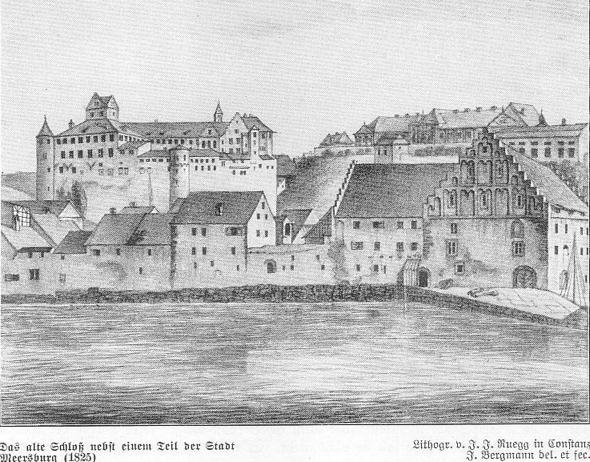 Meersburg 1852 Lake Constance was the scene of his youth as well as his old age. There he lived for a time with a female cousin who kept house for him. He was known to be temperate with food and drink. Mesmer didn’t read much and rarely attended church. But, he still treated patients. He also involved himself in modeling and drawing, study, writing and music. Mesmer’s favorite instrument had somehow followed him in all his travels and remained in his hands till the last. The Doctor continued to play his glass harmonica and sometimes added his “enchanting” tenor voice to his melodies. (Long ago, Gluck had advised that he should only improvise on the harmonica.) Mesmer could by music and magnetism and presence still influence people profoundly. A visiting Viennese doctor in 1804 described his response to Anton’s glass harmonica: “a shiver caused by the instrument [went] through my nerves until I got used to it. Many of the phenomena of magnetism must have been brought out by the extremely penetrating tones of this music.” Mesmer was deeply aware of the power of music. Neither did the value of laughter in healing escape him. He used his sense of humor in extraordinary ways. It is told that he once made a recommendation to another visiting physician regarding the use of water: “It is because flowing water is shone upon by the sun and you must know that water shone upon by the sun has virtue superior to all other kinds, as it is like magnetized water.” The visitor didn’t know what to think, nor have most of his biographers when the Doctor could not resist adding, “As far back as twenty years ago I magnetized the sun and for that reason it is more efficacious than it was before.” His humor was balanced by other traits as shown when he entertained Dr. Johann Heinrich Egg who came from Zurich to see him in 1804. Dr. Egg was impressed by Mesmer’s vigor, knowledge, and friendliness. He also was soured when the old man drew into himself reading his manuscripts in French for hours. “Dominant in this man was an almost unlimited egotism. The manner in which he rejected the views of others and the egotism with which he spoke of himself, his great discoveries, and the great benefits to mankind which he had produced, were almost unbelievable. It may be said with confidence that he considered himself not only to be the greatest man among his contemporaries but greater and more meritorious than all other men who lived before him or were yet to come. A painting which hung in his living room may serve as proof; it showed Mesmer as the genius of humanity celebrating the victory of animal magnetism over the contemptible art of medicine. Beside his portrait, there was a copper engraving with French verses deifying him, which he presented to his friends, and his ‘Account of the discovery of animal magnetism, to be inserted in the dictionaries of physics and medicine’ and much more which might be mentioned. Generally, when his ego and his discoveries were discussed, his last word was an ill-tempered complaint on the world’s ingratitude, on the defamation and ill will of the physicians, and regret that with his death his discoveries might no longer exist.” “While he thought that he had found the key to all human wisdom, he did not concern himself in the least with the knowledge acquired by others nor in the progress of the sciences. He read, except for some few newspapers, nothing at all.” Another Swiss physician reported on his visit to Anton Mesmer in 1809. Dr. Zugenbuhler commented that, “He does not lack scientific education and acumen, but these qualities make him one-sided, so that finally he saw nothing in the universe but mesmerism, I had to smile when he told me that all diseases without exception could be cured by animal magnetism, and miracles and premonitions could be produced by the same force, but I could not hold this man in contempt because of these fixed ideas. Extensive experiments by credible men have proved that the mesmeric phenomena are not mere chimeras, and it would be interesting to have a detailed explanation of the natural phenomena from Mesmer himself. A manuscript is already completed, as he told me, but no publisher will undertake it at his own expense. It is not enthusiasm but conviction that sustains Mesmer in his old age, and a treatise by him on this subject would be very welcome now, when people are beginning to judge it in the right way.” Another visitor from Jena, appeared in the same year. The German biologist Lorenz Oken, who was a leader in his country of the movement known as “the romantic philosophy of nature,” spent a day and a half with Mesmer. He found the 75-year-old lively, cheerful and sociable. While spirited and keenly devoted to his own system, Dr. Mesmer had lost touch with the sciences and medicine outside his own realm. The old Master “assured me that (1) several days before the appearance of a disease he was able to perceive the predisposition to the disease, (2) he was able to determine the place in the body from which the disease originated, and (3) in most cases prevent the disease from appearing. About the year 1800 he had sent a circular letter to all ambassadors in Paris so that they might transmit news of his discovery to physicians, to test his doctrine in hospitals, but to this he had received no reply.” (Pattie) Mesmer had not given up even as he approached the age of 80. He republished his “Letter to Citizen Baudin” on smallpox and the need for preventing the disease at birth. But, he was working on larger ideas, even political ones which had been stimulated by his time in France during the Revolution. Mesmer received further evidence that his discoveries had not been totally forgotten by the larger world. For more than twenty years, Mesmer had been ignored – at least outwardly – by the scientific world. Still, Frenchmen had tried to recall him a number of times and later the Germans. Prussia almost succeeded in 1811 when Professor Johann Christian Reil, head of the Prussian Faculty of Medicine, read Oken’s report of his visit to Mesmer in Frauenfeld. Reil invited Mesmer to demonstrate his methods in Berlin. Mesmerism had found adherents here and there, in fits and starts over the years. By way of Strasbourg and then through Lavater’s method, it entered Germany, especially in Swabia and around Berlin. In 1812, the learned and famous Dr. Christoph Wilhelm Hufeland, court physician to the King of Prussia, spoke to Frederick William about the possibility of renewing the study of animal magnetism. After all, it had been discovered by their own native German, Anton Mesmer. Another commission was appointed and began its review. A member came up with the obvious question, “Why not send for Dr. Mesmer himself?” and thus seconded Reil’s appeal to the Master magnetist. The Prussian Academy sent an official invitation to Herr Mesmer to come to Berlin and lecture on his work. It was suggested that he even consider moving to Berlin. Mesmer could but laugh that it had taken “only 40 years” for his fellow Germans to pay real notice to his discoveries. He was well aged though hardly infirm. But, he had insufficient interest to make such a journey and effort. “I only have a few years to live. I can best use them in exercising my profession and continuing my experiments.” Mesmer may still have been smarting from public hurts of the past. At the time, he wrote to Oken that he would “not go into the land of the unbelievers.” Still, Mesmer did agree to be interviewed by Dr. Karl Wolfart in September. Wolfart, who had been practicing magnetism for fifteen years from early in his career, wrote Mesmer that he had great success with the baquet. He was sent as royal commissary “to visit Mesmer, the discoverer of magnetism, and to obtain from him all information which can contribute to the confirmation, rectification, and illumination of the important matter …” 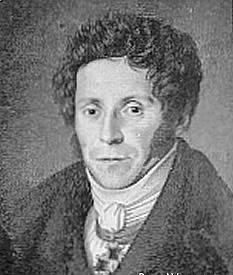 Karl Wolfart Professor Wolfart traveled to Meersburg, whence Mesmer had made his final move, and spent a month with the still fascinating Doctor. Wolfart found himself impressed in almost every way by the 78-year-old’s vivacity and energy, clarity and charm, keen intelligence and broad knowledge. The German visitor was taken especially by the Maestro’s playing of the glass harmonica: “His soul entered into the music, and such a harmony of the spheres as was this music I have never since heard.” Wolfart was taken as much by his popularity as by expansive personality. Patients came from far and wide to see him. They revered him, especially the poor ones. His diagnostic and healing powers were undiminished. Wolfart was keen to state that his therapy had nothing to do with “imagination” or showmanship. He believed it to be based on the profound rapport the great healer was able to create with his patients. Mesmer’s healing powers were still intact: “His marvellous skill in treating the sick by his penetrating gaze or merely by his raised hand inspired feelings of awe in the beholder.” Wolfart stared as Dr. Mesmer forcefully cured a 17-year-old girl of an unnamed complaint. Professor Wolfart discovered that Mesmer had lost most of his papers as well as his fortune due to the turmoil in France. But, he had slowly set about re-writing the ideas and work he had developed in Paris. Methodically, Dr. Mesmer had been resurrecting Animal Magnetism on paper for twenty years. He placed his collected papers – a manuscript – in the hands of the thoroughly awestruck visitor who carried them to Berlin.h Wolfart then edited and published in 1814 Mesmerismus ober System der Wechselwirkungen … [Mesmerism, or the System of Reciprocal Influences; the Theory and Practice of Animal Magnetism as a Generally Applied Treatment Which Will Preserve Mankind]. The Mesmerismus was a large volume divided into two parts: Physics dealt with matter and motion: the physical universe and man; Morals was devoted to life in society, government, education, ethics, and religion. For the open-minded, the Mesmerismus offered numerous examples of Mesmer’s innovative and far-sighted thinking. Dr. Wolfart returned to his work with animal magnetism but little general notice was taken of the Mesmerismus. Still, Wolfart was subsequently appointed Professor of Mesmerism in the Academy of Berlin and published a journal called Asklepion for several years. A 300-bed hospital was founded and dedicated to Anton Mesmer. The chief therapy used at the institution was Mesmer’s magnetism. Until his last days, Mesmer was still treating and curing patients, sometimes driving his carriage many miles to attend a patient. His magnetic faculties were undiminished and used readily when the ill sought his aid. He played his glass harmonica and sang, modeled and sketched most every day. He even persisted in continuing his brand of scientific experiments. 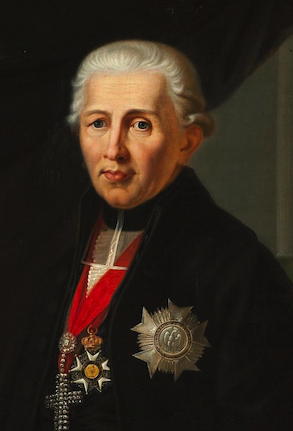 Bishop Prince Dalberg
In the final year of his life, Herr Doctor drove his carriage every Sunday to attend the fine concert held at Bishop Prince Dalberg’s residence. Dalberg had been opposed to Mesmer’s doctrines in earlier years. But after Dalberg came to live near the Doctor in Meersburg, he became a believer as well as a friend and extended his hand in warm welcome at his weekly concert. Mesmer seemed very proud to be so received. Although a loner by nature, Mesmer was still quite capable of being sociable, cheerful and conversational especially in regard to magnetism. A few educated people stopped by in his latter days, most notably Drs. Hirzel and Waldmann. Relatives visited along with two young and curious priests, Schreiber and Fessler. One of the priests had been restored to health from a grievous illness thanks to Mesmer’s ministrations. Mesmer’s life was simple, but authentic. He kept a good table laden with fine wines, fat hens and fish, fruits and vegetables of the season while he preached that man was omnivorous, not content with one kind of food. His housekeeper planted a garden where Mesmer dug and weeded and raked. But, he more often tended plants, flowers, laurels in a special interior room. He treated them carefully with his own inimitable brand of magnetism. Mesmer loved all animals, especially horses and birds. He was very fond of the horse which pulled his carriage on daily rounds. But, the favored creature of his latter years was a canary which had come to roost on his shoulder when he visited the bird sanctuary at the nearby island of Mainau. Birds seemed to follow him wherever he walked on the island. Eventually, one canary returned with him on ship. The yellow bird became pet and companion at Mesmer’s home. Every morning at seven, the little bird would fly from its cage, always left open, to perch upon Mesmer’s head and sing him awake. Later, he would perch on the sugar bowl while Master had his breakfast. If an extra lump of sugar for the coffee cup was needed, the bird readily obliged. The canary was also one of Mesmer’s favorite magnetic subjects. The Doctor could always demonstrate his strange power. A light stroke of the hand would put the canary to sleep and another stroke in the opposite direction would awaken the little bird. Mesmer rewarded the creature often with morsels of its favorite grains. Mesmer’s magnetic influence made it easy for him to attract and tame all manner of animals. His devotion to nature brought him into a natural sympathy with living creatures as he blended with their own instinct. The inner sense of man met the same in animal. The magnetic fluid did its mysterious work with birds and beasts just as with man. When its waves were harmonious, transference of thought, feelings and vitality moved freely in all directions. Anton Mesmer died in 1815 awaiting his young priest friend Fessler to come and play the glass harmonica for him one final time. The Master Mesmer took his leave peacefully with his canary at his side. As the Doctor breathed his last to be re-absorbed into the wider harmony of the universe, the little bird returned to its cage. At seven the next morning, the canary did not appear at Mesmer’s bedside. Neither was the bird on its perch. The body of the little feathered creature was discovered stretched cold on the sanded floor. Its tiny heart had ceased to beat soon after the great old one. By the time of his death, Mesmer had rebounded from the days of his financial woes. He had then three servants, a horse and carriage and an estate worth 7000 florins. His money and property were willed to his six nieces and nephews. Mesmer’s library contained only “eight books by various authors.” He likely was one of those authors. Mesmer made the request that no funeral be held on his passing. It was not honored. Meersburg friends and neighbors thought otherwise. Father Fessler gave the oration and the citizenry followed the bier to the graveyard where eventually a monument was erected to him by admirers and disciples in Berlin. The monument was made of marble and engraved with figures. Facing east is a God’s eye shining over Mesmer’s name; to the northwest is a depiction of the solar system above his date of birth; to the southwest is a burning torch and palm branch over the date of death; and on the top of the monument is set a sundial. 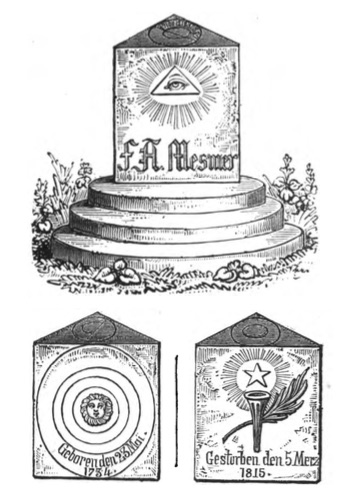 |
Home Page