Le Visionnaire
The physician should be able
to see
that which is not visible to every body. Paracelsus In that eventful year, Dr. Anton Mesmer worked at his Landstrasse home – partially converted into a medical facility. The property had been expanded beyond house, gardens and theater to contain a clinic, hospital rooms, dispensary and research laboratory. Mesmer was then attending a number of “incurable” cases, some in his clinic and others in his hospital. Dr. Mesmer became known especially for treating paralysis, tremors, intermittent fevers, melancholia, epilepsy, suppression of menstruation and “all the cases of hypochondriac, convulsive, and hysterical diseases which have come to me.” He also drew to himself a number of young people with visual disorders. Mesmer seemed to be fascinated with the sense of sight professionally as well as personally. The “vaporous” conditions to which Mesmer gravitated in his work were poorly explained by the physicians of the day. Mental and nervous disorders were attributed to such causes as brain weaknesses, hardening of nerves, animal spirits, and assorted occult influences. Many such diagnoses were considered acceptable by physicians of the day as Anton Mesmer worked with his doctrine of Magnétisme animal before the public eye and his own Faculty of Medicine. (Remember that Anton de Haen was a student of witchcraft and accepted Father Gassner’s healing exorcisms.) The word spread about the Doctor’s relatively painless methods, gentle manner, lofty beliefs, frequent successes, and occasional miracles. His name was heard in circles beyond the Austrian capital for a growing list of reasons. Besides ranking socially and educationally with the elite, he was known as a physician who got results with his often very disturbed patients. With all his studies and degrees, Dr. Mesmer was likely the most educated man in Vienna. As Mesmer’s practice and fame grew, he invited fellow physicians to visit his hospital. He dearly wanted them to see that his work was really conducted on scientific lines. Even though his kind of science was much different than the practice common for the day. But, none volunteered to visit Mesmer at work. They wished nothing to do with the strange phenomena associated with his hospital, however sanative they might be. He wrote to the Bavarian Academy of the Sciences at the time: “I am continually making fresh physical and medical discoveries. But as for my hope of finding a satisfactory explanation, that is frustrated by the baseness of the opposition I am unceasingly compelled to face. I am accused of being a common cheat, and those who believe me are taunted with being fools. Such is apt to be the fate of new truths.” Worse still, a back-handed campaign developed in Vienna to discredit his magnetic cures. Articles began to appear in German and French language newspapers decrying his methods and ridiculing their practitioner, sometimes making libelous commentary. They were often published anonymously. But, Mesmer’s plate was clean. Scrupulously so. No direct assault could ever harm him. Inevitably, Herr Joseph Anton Paradis consulted Doctor Anton Mesmer and could not resist putting his daughter into his care. One further attempt to help his poor disabled daughter by placing her in the hands of the visionary doctor seemed more than warranted. Expectations were not high as Dr. Mesmer only committed to treat her sad protruding eyes and melancholic state “which often erupted into attacks of fury and delirium.” There was no talk of getting her to see again, but the possibility was hardly denied. Still, Mesmer could not resist using his methods to bring sight back to the young woman. He thought, “This child has been through enough torture at the hands of Vienna’s ‘finest’ physicians as well as her parents. I surely can get her some breathing room by bringing here to my hospital. Away from her fuming father and hysterical mother. Quickly, we can stop those spasms of her eye muscles and restore her face to some kind of normalcy. Light yet may reawaken in her being. Her visual organs are quite unimpaired according to every examiner. Her pupils respond to light and sight may yet flow through those sad eyes. And what better way to get the attention of Her Majesty and the Old Vienna School.” Paradis and Mesmer made plans. Even though Baron von Stoerck, the new President of the Medical Faculty, was not fully supportive. Stoerck had told Paradis, “Mesmer’s treatments couldn’t harm a fly.” With or without orthodoxy’s endorsements, Dr. Mesmer’s work could not be denied. This was especially the case after Mesmer’s cure of Francisca Oesterline. “The first fruits of my success.” In more recent times, Mesmer was treating in his home hospital a 19-year-old orphan Zwelferine who had been blind since age two. He cared for 18-year-old Ossine who was diagnosed with phthisis (consumption) and melancholia. Further, he was trying to help Count de Pellegrini medically and magnetically when the young Paradis woman entered his care in January 1777. Soon after treatments began, Herr Paradis made arrangements for his lone daughter to stay at the House of Mesmer. All other patients were tended in guest houses or cottages and supervised by helpers. Maria-Theresia was attended by the Master himself and his most accommodating wife. Mesmer tried to make the best of the situation, acting with due caution and patience. He brought forth the greatest of his skills of sympathy and suggestion, paternal solicitude and care, as well as his inimitable brand of charm and magnetic influence. Dr. Mesmer had the utmost though undeclared confidence that he could bring light to pass once again through Maria-Theresia’s blighted orbs while stirring her shuttered being. Mesmer understood Paradis’s problem quite well for a physician of the 18th century. (But not well enough as time would show.) In simple terms, her blindness was due to the potent emotions, strong sensitivities, and persistent blocks which overlay her resilient physical frame. He confirmed the findings of Dr. Joseph Barth (Professor of Diseases of the Eye) and others that, “The optic nerves are unimpaired.” Unlike his professors, Mesmer knew she could be treated magnetically and benefit to the point of having her vision restored. Paralysis of bodily nerves often responded most dramatically to Mesmer’s touch. Why not paralysis of optic nerves? Still as Mesmer took Maria-Theresia into his care, he must have shuddered a few times at the task before him. Just the spectacle of those twitching, rolling eyeballs surely caused him to step back and stand in wonder. The girl’s shifting moods and occasional fits added to the tests at hand. He was acutely aware that her “dead eyes” were only the outward manifestation of a highly emotional nature. She was easily infected by the feelings of others. She caught and absorbed their dis-eases. Maria-Theresia also had gathered more pain and sickness at the hands of her doctors. Their ministrations added to her burden. Thankfully, Doctor Anton was different – very different – and would bring her life and health instead of pain and distress. Mesmer took to his huge task charged with his unique vitality and utter generosity. He methodically shed his vital magnetism upon his patient, at the same time preparing her for the return of the long-forgotten light into her world. He readied the young woman as much as he could, according to his experience and talents, imagination and philosophy. He had, however, little considered what “side effects” of returned vision might accrue within as well as around her. Fraulein Paradis was treated gently but expectantly with magnetic passes focused over her head and eyes then continuing again and again to her epigastrium (solar plexus). Stroking her body lightly, almost imperceptibly to cleanse her disturbed magnetic fluids and then replenish them. While Maria-Theresia could appear hale and hearty at times, she yet was depleted easily and the flow of vitality to her eyes needed repeatedly to be rebalanced and harmonized. Treatments were made over extended periods of time each day. During the course of her therapy, the Doctor reminded her often in many ways that, “The whole of the universe is animated by a living vitality. We are sustained and all connected one to another by impalpable currents of force and waves of magnetism. Such give life to the stars as well as the ants. And we who stand in between benefit equally. The harmony of the spheres reaches down to touch, enliven and heal us. But, its fluid can be transmitted successfully for healing purposes best when we have tuned our instruments to be played upon by the Maestro.” Maestro Mesmer put his favored instrument, the glass harmonica, to use in his work with Maria-Theresia. And she responded accordingly. “You react to the deep and pure sounds with such intensity. They touch the chasm of torment which has been borne forth in your life. As the pain is dissipated, you will come steadily closer to the true harmony which has been submerged in your soul.” Wolfgang Mozart’s presence would have been a splendid addition to Dr. Mesmer’s therapeutic regime had he not been in Paris during her treatments. Like his great friend Mesmer, Mozart well knew the healing power of music. Wolfgang and Maria-Theresia had crossed paths on a number of occasions and Mozart took her under his wing when they met in Vienna. He developed an affection for her as one musician for another. 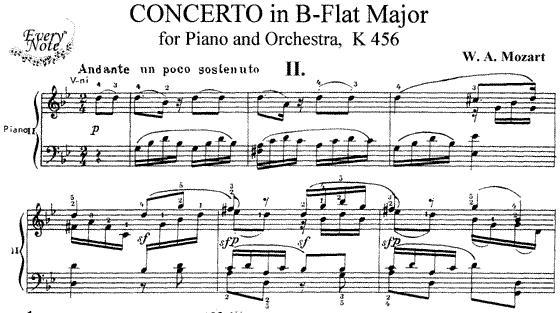 When they played duets, Wolfgang worked around her hands as well as the melody leaving the Paradis girl to stifle giggles and affection. He drove the music with his light, quick, assured touch. After all, he was not just an acclaimed composer but also a genius at the pianoforte. Mozart could improvise on the keyboard like none other. Their duets “were the greatest joy to me.” There he sat next to a silly blind girl struggling to contain her music and her feelings. She held back those giddy feelings which appeared whenever Mozart was in the same room with her and especially when he sat next to her at the piano. Mozart made her laugh and smile for times well worth remembering. Wolfgang always seemed to bubble with enthusiasm. He encouraged his musical friend to play for him and listened with great intensity and pleasure. Mozart set her to playing her own compositions. Then, he put her to variations, changes in tempo and rhythm. Mozart was Mozart. He knew his work and his worth. He addressed people in the same manner and paid little attention to her blindness, nor to her occasion emotional outbursts. He treated her as an equal, maybe better than. Mozart also knew the wonder of music in general and his own in particular. His magical music has manifested healing effects on countless occasions over the past two hundred and fifty years. Epitomizing his simple sensibility, Mozart proffered one of his own axioms regarding music and medicine which certainly had bearing on the Paradis girl: “Patience and tranquility of mind do more to cure our distempers than the whole art of medicine.” In later years, Maria-Theresia stopped off during a three-year tour in Salzburg and commissioned Mozart to write for her a piece which became the Piano Concerto in B-flat (K.456). Their personal and professional connection continued until Mozart’s death in 1791. Doctor Mesmer treated the young Paradis woman in a futuristic, holistic, and multi-dimensional manner. His methods were wholly unique for his time and place. Even in the modern world, they would be seen as extraordinary and unusual if not advanced. Besides his magnetic and musical therapies, Anton drew upon his generous Jovian spirit, sympathy for suffering humans, and his sincere and suggestive words. Maria-Theresia absorbed strength from all his ministrations. Since she was so acute of hearing, she relaxed and reveled in the Master’s soft and gentle, coaxing but commanding voice. His words were supportive and suggestive as well. “The force of the Universe is at our disposal. I draw from the Sun, the Moon, the Stars, and all of Nature. I concentrate and pass it on to you. Can you feel it?” In the midst of her therapies, Maria-Theresia was encouraged to practice and play on the new piano forte Mesmer had purchased especially for the Fraulein’s appearance at Landstrasse. In those moments, her being changed dramatically. Then, her face became full, expressive and mobile. Her blindness was lost in her music allowing her features to express the breadth of her musical talent and depth of her spirit. When riveted to her repertory, she displayed ease and comfort, peace and poise. Within days, Maria-Theresia’s eyes stopped quivering and her face calmed as did her whole sensitive being. Then, Doctor Mesmer began to make incremental preparations for Maria-Theresia’s eyes to open to the world of sight. He was quite aware of the potential for disturbance from shocks of light entering into long-darkened spaces and tightly-guarded centers. So, he had windows draped and her eyes bandaged. As light returned into her awareness, she began to suffer pains at the back of her head. Sometimes, she felt like her head was splitting in two. Then, she agonized as the forces concentrated behind her eyes. It was somewhat akin to pricks she felt when the Old School doctors shocked her eyeballs with electricity. Her exquisite sensitivity to the light was really a wonderful sign that the mechanism of sight could yet be engaged. Her own inner light was reacting to that of the outer world. Maria-Theresia’s fluids were active and responding to those that surrounded her. But, only gradually did Mesmer allow her to be touched by the light while inner transformations drew nye. How fragile and tentative can human life be until it is brought into harmony with the ebb and flow of greater forces. The young woman was reticent but not deterred from telling Mesmer of her worries. She was offering him her eyes to experiment upon. Her aching heart and mind had to be open to him as well. “Herr Doctor, I have been blind so long. I am afraid of what I have forgotten. I was so small when the lights went out. And I do rather well in my darkened state. I am used to it. Aren’t you just a bit concerned about what may happen to me when my eyes are uncovered? Will I gain from return of sight? Can we know ahead of time? How will Mama and Papa deal with a sighted daughter?” “Dear child, we know ever so little and can know so little. This is an experiment. But, so far it has been relatively painless compared to the treatments of the past. Has it not? You have already been through so much. You have passed through so many crises before you came to my house. Now, you have relaxed and breathe more freely. Your overall health has improved in these few days. Your eye muscles do not twitch any more and your face is almost at ease. We must be patient in preparing for what lies ahead. “You sense something is about to change! Do you? Will you be better for having regained my lost sense? “Seeing will neither be better nor worse. Its recovery will neither be instantaneous nor without complications. Sight is just another faculty that most of us have for most of our lives. It gives us another way to discover and relate to the world and its people and creatures. You will have whole new challenges and undreamed of opportunities. “Already, you have begun to lighten up – the light is beginning to get through – since you have been here. You are opening all sorts of blocked pathways. New avenues to experience and awareness await you. Let’s try to allow the experience to unfold. Healing occurs much like the flowering of the roses whose smell you so adore. Wait until you can see them open to the light.” Inevitably, the delicate Maria-Theresia sensed the reawakening of her visual organs. There appeared a diffuse radiance which even in small doses tended to overwhelm the young woman. “Oh, my head is beginning to glow. It is scary, strong, upsetting. What do I do? It is beyond taking in. I want to run, cry, hide. Turn it off. I can’t bear it!” So, the curtains were drawn back and the bandage doubled over. Commencement and graduation didn’t occur in one moment. The process was step by step. When the girl was obviously overwhelmed, the Doctor retreated. When she showed that she was tolerating the pace, it was quickened but so slightly. Still within a fortnight to the surprise and wonder of practically all concerned, the hopelessly blind Maria-Theresia Paradis was able to have her eyes uncovered in subdued light. Her tics and tremors having subsided days past, the young woman amazingly began to see again after more than a dozen years of darkness. She was able to distinguish colors and shapes. But, the girl stuttered when asked to put names to things, as if that would amount to capturing them. “They must be free and have their own space.” Still in many ways, every thing was a blur to Maria-Theresia. Rooms and furniture seemed so alien. Walls could have been miles away. The piano, which stood near a window, was lost to her in a pool of darkness. The motion of things was even more of a surprise. The visual world – like her music – was always moving. Perceptions of distance and size became major conundrums to the Fraulein. At one moment, she tried to capture the Danube in her hand and then imagined bringing the Prater meadow through the window frame into her grasp. In the next, she thought furnishings in the house were going to engage and absorb her. It was all very foreign and intimidating to the young woman. She was clearly out of her element. “Oh, Doctor. I am so muddled. I don’t know what I see. I feel like I am three years old again.” But, Herr Doctor was hopeful and supportive and charming. “You are doing so well. Be patient with yourself. Children do this process over months and years. You are making these discoveries in a few days.” A real test came the day, three weeks into her treatment, that Dr. Mesmer decided that Maria-Theresia should experience the view of a human face. Whose face? His own. Anton might well have given her better warning, but this was relatively new territory even for himself. Having set the stage and adjusted the lighting, he merely told her, “We will now have your bandage removed so that you can peruse a human face.” This was a totally different moment from previous experiments. With the bandage removed, Fraulein Paradis twittered her eyelids, squinted, and then a blurred image gradually took hold of her imagination. “Oh, my! There are hills and valleys and dark places. Not much light. It is really scary. What is that mound in the middle? Oh God, this is terrible! Is this the image of man?” First, she was scared. Then, she was lost. Suddenly, she heard the sigh of Herr Doctor and realized that it was his face which fearfully filled her infantile field of vision. Maria-Theresia screamed a little, grimaced a lot. When the air went out of Mesmer’s pursed lips, she let out a giggle. Then, Herr Doctor snickered. Then, the room of onlookers erupted with hearty laughter. The doctor’s ego was pricked for but a moment. He gently grasped the girl’s hand and carried it to his face to let her explore the territory with another sense. She began to understand that the great mound was his big nose. The valleys were his eye sockets and mouth. It took her some time to begin to become comfortable with the great man’s visage. Fortunately, the experiment was soon repeated with the family dog as the subject. To the relief of all, Maria-Theresia accepted the creature’s mug with joy and merriment where its owner’s had created such bafflement and horror. “This dog pleases me better than man – at least, his appearance is more endurable to me.” The word went forth that sight was returning to the eyes of Maria-Theresia Paradis. “A miracle!” “Oh, what joy!” “Praise be to Doctor Mesmer!” “Thank God!” But, what did the young woman really see? How did she sense the world lost to her for the past fourteen years? What was it that Dr. Mesmer had really accomplished with the young woman? Would the transformation hold? How much of her cure was due to animal magnetism and how much to the charm and suggestion of the Doctor and the fascination and imagination of Maria-Theresia Paradis? What would the fallout be from the Miracle at 261 Landstrasse? How would the young woman’s life be changed? How might this healing moment influence the medical, social and intellectual world of Vienna? Joseph Anton Paradis gave his own testimony which was published at his instigation (in German) and widely distributed in March of 1777 just two months after the experiment began. In it he described his daughter’s medical history and treatment at the hands of Dr. Mesmer as of that date. Maria-Theresia Paradis, only daughter of M. Paradis, Secretary to Their Majesties the King-Emperor and Queen-Empress, was born at Vienna on the 15th May 1759; her eyesight was perfectly normal. On the 9th December 1762, it was found that when she awoke she was unable to see. Her parents were all the more surprised and afflicted by this sudden infirmity because, since her birth, there had been no indication of any change in that organ. It was ascertained that it was a case of perfect amaurosis, whose cause might have been a fluid with repercussions, or some fright the child had had that night, some noise at the door of her room. Her parents were in despair and employed all the methods considered most suitable for curing this infirmity, such as blistering, leeches and cauterising. The first of these methods was applied very intensively as for over two months her head was covered by a plaster, producing continual suppuration. For a number of years purgatives and diuretics were used as well, together with pulsatilla and valerian root. These various methods met with no success. The patient’s condition was aggravated by spasms in the eyes and pupils which, as they approached the brain, gave rise to transports and awakened fears that she had gone out of her mind. Her eyes bulged and were so much out of place that as a rule only the whites could be seen; this, coupled with the spasms, made her appearance disagreeable and difficult to endure. Last year, electricity was resorted to; it was administered to the eyes by over three thousand shocks, and she bore up to a hundred in each treatment. This latter method was fatal for her, and so much increased her irritability and spasms that it was only possible to preserve her from harm by repeated bleedings. Baron de Wenzel, during his last stay in Vienna, was instructed by Her Majesty to examine and assist her, if possible, after the examination. He said he thought she was incurable. In spite of her condition and the pain that accompanied it, her parents omitted nothing to educate her and provide distraction from her suffering. She had made great progress with music, and her talent at the organ and harpsichord had won for her the happy fate of becoming known to the Queen-Empress. Her Majesty, being touched by her unhappy condition, was kind enough to grant her a pension. Dr Mesmer, a physician who has been known for some years through the discovery of animal magnetism, and was present at the first treatment given her in childhood, had been observing this patient particularly attentively every time he had an opportunity of meeting her. He obtained information regarding the circumstances that had accompanied the malady and the methods so far used for treating her. What he found most unsatisfactory and appeared to give him anxiety was the manner in which use had been made of electricity. In spite of the stage reached by this malady, he gave the parents some hope that he would restore the eyes to their natural position, by alleviating the spasms and calming the pains, and although it was afterwards known that, he had then and there entertained the hope of restoring her eyeÂsight, he made no mention of this to the girl’s parents, who, as the result of unhappy experience and many setbacks, had resolved to make no further attempts at a cure which they considered impossible. M. Mesmer commenced his treatment on 20th January last; its first effects were of heat and redness in the head, and then she had a trembling feeling in her legs and arms. Next she felt a slight tug in the back of her neck, which forced her head backward and, becoming stronger, increased the convulsive agitation of her eyes. On the second day of treatment, M. Mesmer produced an effect that greatly surprised the persons who witnessed it. Seated beside the patient, he held out his stick [wand] towards her face reflected in a mirror, and as he moved the stick, so the patient’s head followed its movements. This sensation was so powerful that she herself announced the different movements of the stick. It was soon observed that the agitation in her eyes increased and decreased alternately in a very appreciable way; their movements multiplied both outside and inside, and were sometimes followed by complete repose. She was relieved from the fourth day onwards, and her eyes resumed their natural positions, it being noticed that the left-hand one was smaller than the right-hand; however, as the treatment went on, they became the same size again. The trembling in her limbs ceased a few days afterwards, but she complained of a pain in the occiput which penetrated her head, increasing towards the front. When the pain reached the part where the optic nerves are connected, it seemed to her for two days that her head was splitting in two. This pain followed the optic nerves, dividing like them. She defined it as a series of pinpricks which, as it advanced slowly towards the eyeballs, penetrated them and multiplied there, spreading through the retina. These sensations were often accompanied by jerks. The patient’s sense of smell had been affected for some years and there was no further secretion of mucus. Her treatment caused the inside of her nose to swell, together with the adjacent parts; this was relieved after eight days by the copious discharge of a green, viscous substance. At the same time she had an extraordinarily abundant attack of diarrhoea, the pains in her eyes increased and she complained of giddiness. M. Mesmer thought that these were the effect of the first impressions of light, and he thereupon had the patient to live in his house, so as to take the necessary precautions. The sensitivity of her eyes was such that after covering them with a triple bandage, he was obliged to keep her in a dark room, as the slightest sensation of light on any part of her body affected her to the extent of causing her to fall. The pain which she felt in her eyes varied continuously. At first it was general and smarted, then it took the form of a violent irritation, ending with a sensation similar to that produced by a fine brush drawn across the retina. These progressive results gave M. Mesmer grounds for supposing that the cure was sufficiently far advanced to give the patient her first idea of light and its changes. He removed the bandage, leaving her in the darkened room, and besought her to pay attention to the sensation in her eyes, before which he placed alternately black and white objects. She explained the feeling produced in her by the former as if fine points were inserted in the eyeball, the painful effect of which proceeded in the direction of the brain. This pain and the various sensations that accompanied it increased and decreased proportionately to the degree of whiteness of the objects in front of her. M. Mesmer then ceased using these and replaced them by black objects. Through these successive and opposite effects, he showed the patient that the cause of these sensations was external, and that they differed therein from those she had had hitherto; Thus he succeeded in making her realise the different degrees of light and its absence. To continue his instruction, M. Mesmer exhibited different colours to her. She then perceived that the light impinged more gently and left her with some impression, and presently she distinguished colours by comparing them, but was unable to remember their names, in spite of possessing a very good memory. On seeing black, she said sadly that she could see nothing, and was reminded of her blindness. In the early days, the impression of an object on the retina lasted one minute after beholding it, so that to distinguish another and not to confuse it with the first, she was obliged to cover up her eyes as long as her first impression lasted. She was able to distinguish in darkness where other people had difficulty in seeing, but she gradually lost this ability as her eyes began to admit more light. The motor muscles of her eyes had not hitherto been in use, and she had to be taught their use for controlling the movements of the eyes in searching for objects, seeing them, focusing on them and giving their position. This tuition, of which it would be impossible to enumerate the countless difficulties, was the more painful in that it was often interrupted by attacks of melancholia, one consequence of her malady. On the 9th February Mr Mesmer attempted for the first time to make her see faces and movements, and he himself appeared before her in the darkened room. She was frightened on beholding the human face: the nose seemed absurd to her and for several days she was unable to look upon it without bursting into laughter. She asked to see a dog which she often fondled and the appearance of that animal seemed more pleasing to her than that of man; Not knowing the name of the features, she drew the shape of each with her finger. One of the most difficult parts of the instruction was teaching her to touch what she saw and combine the two faculties. Having no idea of distance, everything seemed to her to be within reach, however far away, and objects appeared to grow larger as she drew near them. The continual effort she had to make to overcome her clumsiness and the large number of things she had to learn sometimes troubled her to the point of causing her to regret her previous condition, especially as, when blind, people used to admire her skill and intelligence. However, her natural gaiety soon got the upper hand, and M. Mesmer’s continual care encouraged her to make fresh progress. Little by little she succeeded in supporting daylight, and distinguishing objects, perfectly at any distance. Nothing escaped her, even the faces painted on miniatures, whose expressions and attitudes she imitated. She even possessed a singular aptitude for judging with astonishing accuracy the character of the persons whom she saw, by their physiognomy. The first time she saw the starry heavens she expressed astonishment and admiration, and since that moment all objects shown to her as being handsome and pleasing seemed to her very inferior to the appearance of the stars, for which she expressed a decided preference. The large number of persons of all conditions who came to see her caused M. Mesmer to fear that she might become unduly fatigued, and caution induced him to take precautions to this end. His opponents made use of this, as well as the lack of dexterity and helplessness of the young lady to question the genuineness of the cure. However, M. Mesmer declares that the organ is in perfect condition and that she will make the use of it easier by exercising it diligently and with perseverance. Herr Paradis’s report revealed much about his daughter’s medical and mesmeric experiences and must have given previously unimagined hope to many involved in her life. All sorts of witnesses were thrilled by her progress. Verbal support and praise even from medical brethren rolled in for a time. Paradis was so excited that he pushed von Stoerck, Medical Faculty President, and other doctors to pay Mesmer and his daughter a visit. They confirmed what Paradis reported. Mesmer later recounted that, “Stoerck was well acquainted with the young girl, for he had treated her for ten years without the slightest success. In expressing his satisfaction with the results of his examination he said he regretted his long delay in acknowledging the importance of my discovery. The other physicians with him individually followed his example in acknowledging the truth.” Paradis was brought to task many times for his testimonial. Yet, he never fully divorced himself from his encomiums to Dr. Mesmer. However, he was wont to suggest that he, as others, was for a time under Herr Doctor’s magic spell. “You must give the devil his due. There is a bit of genius in the man, however twisted it may be.” Maria-Theresia’s life was being challenged and changed tremendously. And not all for the seeming good as the improvements occurred in the face of her years of becoming accustomed and adapted to blindness. She even had benefited by her lack of vision. The changes in her vision were clear to those who wanted to see. But, she was like an infant, just beginning to use her senses. Maria-Theresia’s eyes were extremely sensitive to light and had to be slowly accommodated to it. Her perception of colors and forms and figures developed in fits and starts. She had problems putting names to items presented to her. The sense of distance and perspective escaped her immediate grasp. In the past, she had accustomed herself to feel her way through a room and became quite adept at the process. With her developing vision, those movements were fraught with wonder and worry. Instead of feeling her way around, the woman had to fit her body into the space visually. A quite different experience which required her to search and test and try to blend the sense of sight with that of touch. The “simple” reflections created by mirrors astonished her greatly. The glaces, which Mesmer had in plenty in his mansion, added more puzzles for Maria-Theresia to attend. They were meant to reflect and intensify magnetic force, just as looking glasses augment the light of a candle placed near. Fraulein Paradis had many challenges which seemed to grow when introduced to mirrors. Her own size became discomforting to her, indeed terrifying. She felt that her body was subject to enlargement and shrinkage. She gradually learned to recognize herself in opposing mirrors as a corridor of persons, diminishing into infinity. At first, the experience was frightening, but later she almost delighted in playing with her partner in the looking glass. At times, Maria-Theresia would put her hands to her face at a mirror – just inches away. Then, she would stare and stare. Conclusions were hard to come by. Humanity became one of her greatest nemeses. Like viewing Mesmer himself, she found her brethren oddly shaped and less than attractive. The rising coiffures, hoop skirts and trains of women seemed absurd especially when she tended to see them as extensions of their bodies. In the midst of all the physical changes, Fraulein Paradis was hardly exempt from her fits of emotion. When things did not go well, she was apt to fall into tears, moments of despair, or the wringing of hands with screams of anguish. But, she bounced back to a positive frame of mind – at least long enough to attempt new experiments with her nascent vision. Clusters of visitors appeared often to see for themselves the wonders Mesmer and Paradis were creating. Her bandage was removed and she was made “to perform her tricks,” as she called them. Like a child, she was asked to decide, “What colour is this lady’s dress?” and “What is the gentleman holding under his arm?” While she soon got sick of performing, Maria-Theresia did create her own pastime with her new eyes. She discovered that she could read portraits. It was much as she had read the quality and character of voices in her blind state. Paradis was able to do the same with portraits and sometimes with the faces of live visitors. When the crowd had departed, she would cry out in distress: “Why is it that I am so much less happy now than I used to be? Everything I see causes me discomfort. Oh, I was at peace while I was blind!” The Doctor did his best to console the young woman for the moment. “Dear child, it is no wonder that with this newborn sight there will be both terrors and blessings. Just imagine what it must be like for babes brought into the world having to open all their senses at the same time.” Even Mesmer, the supremely confident one, knew not what struggles lie ahead for his delicate patient. He could not say if the rewards of vision would match the traumas she must pass through to acquire it. Nor could he even see what problems would come to himself as the result of taking the blind, traumatized girl under his wing and of funneling currents of magnetism to assist her recovery of sight and well-being. Even in the midst of her visual challenges, Maria-Theresia seemed to draw at times from her deeper senses. She gathered long-missed glimpses and hoped-for pictures of her surroundings. And, she was introduced to the wonders of Nature. One evening, Dr. Mesmer opened a window intending to present Maria Theresia with the star-filled heaven. For a moment, she thought her eyes were failing again, “Blind! Blind!” Ah, it was as if she had never seen the night before. The Doctor had to explain how night follows day, one blending into the other. How he was trying to lead her into the daylight. But, the wonder of the dark night would remain so that she could know the harmony of the spheres. Mesmer prepared her for the stars – the organs of the sky, which were not unlike her own. They shine forth even as every human does, in a greater or lesser degree. Then, Mesmer led her to the garden for the full view. For a long time the girl looked at the stars in silence. At last she said in a hushed voice: “How beautiful! How earnestly do those stars gaze down upon me! Nothing can be more glorious than this! If nowhere else, an ardent impulse of worship towards the Highest were felt by the human soul, surely it must be felt beneath this sparkling sky! The stars are the most beautiful sight to my new eyes!” That one view of great heavens may have been worth many struggles for sight. But, the sight of her parents and their pictures of her became extremely important. Maria-Theresia had long thought of herself as being a burden to Mama und Papa. But, they had become accustomed to a different child than they found on visits to the Mesmer hospital. Their daughter had trouble taking them into her vision and her confidence when they appeared. And, the parents had grievous problems accepting the changes in her – those that seemed for the good as well as for the bad. The dawning of Fraulein Paradis’s sight brought not only worries but also seeming threats to Herr Paradis. He repeatedly was told, “If she becomes fully sighted, her future as a musician may be placed in jeopardy? What will happen to her annuity? The Queen may decide not to continue it.” At the same time, a recital was being planned for the sighted pianist to play before the Empress. This, even while many observers began to notice that Maria-Theresia’s piano skills were being disturbed by the return of her sight. They not only observed, but shared comment about the phenomenon. Even as her visual sense was being restored, Paradis began not just to mistrust herself in walking alone. She also became more conscious of her hands when playing the piano. As she did, the trained skills of the blind pianist were often sabotaged. Formerly, her execution was flawless on difficult pieces even while talking to observers. But now, Maria-Theresia would try to use her eyes while at the pianoforte and sense her sure fingers – slip about and miss keys. The memory in her hands got confused with her new sense of sight. Then, her hands and brain began to debate and quarrel enough to disrupt most any piece of music. Her much vaunted musical memory, perfect pitch, and large repertory were then for nought. Once so sure of her musical skills and accomplishments, Fraulein Paradis wept when faltering at the keyboard. She stuttered on easy piano pieces which she had long ago mastered. Her hands betrayed the young pianist and before long so did her imposing parents and her intimidating former physicians. Joseph Anton got caught in the whirlpool one day when watching his child play at the pianoforte. He confronted Dr. Mesmer saying, “You have done enough to my daughter. She has lost her musical abilities. The feeble sight she has keeps her now from doing the simplest of things. She is back to being a blubbering child rather than our musical genius. She needs to be home with her parents. We have had enough of your conjuring.” Mesmer stood firm and coolly responded, “You thought you had a miracle just a few days ago, Herr Secretary. Now, you see otherwise. Your daughter may be seventeen by age. But her eyes are but those of a child and they must be nurtured and cared for accordingly. You also must realize the cure to be done is not just of her vision, but of her mind and heart and soul. There lie huge scars the healing for which will tax even more time and patience. Those are things of which you seem to have so little. Maria-Theresia and I will do the work and you will just have to wait. You will now please leave my house and not return until we have finished what we have begun.” By then, the Doctor knew that Maria Theresia’s treatment would be much more complicated than bringing light through the woman’s eyeballs. Her problems were deep seated, more so than as those of Baron Hareckzy and Francisca Oesterline. The layers of disease were even more tangled in Fraulein Paradis’s case because they stretched out to include her parents, the court and its doctors. It was only days since he published his praises of Mesmer’s wonderful work, but Herr Paradis became more and more agitated after his first outburst at the Doctor. He was frightened and angered. He feared, on the one hand that his daughter’s pension would be withdrawn if she fully regained her sight. On the other, he worried that the return of her vision might cause her piano skills to entirely escape her. In either case, Maria-Theresia would lose out and so would Herr Secretary. There were more worries and agonies for Paradis: those wicked stories spread about Dr. Mesmer, accusations of supposed dangerous methods and maltreatment of his daughter had been planted and re-planted in his little brain. Maybe some of the darkness once largely confined to his daughter migrated and took control of the wretched man and his ragged nerves. What could the poor fellow do but take action? When her father saw she was better, being still egged on by the conspirators, he returned to the charge. He demanded his daughter with some heat and compelled his wife to do likewise. The girl resisted for the same reasons as before. Her mother, who had hitherto supported her, and had apologised for the lengths to which her husband had gone, came to tell me on 29th April 1777 that she intended to remove her daughter instantly. I replied that she was free to do so, but if fresh accidents were the result, she could not count on my help. These words were overheard by the girl, who was so overcome that she went into a fit. She was assisted by Count de Pellegrini, one of my patients. Her mother, who heard her cries, left me abruptly and seized her daughter angrily from the hands of the person who was assisting her, saying: “Wretched girl, you too are hand in glove with the people of this house!” as she flung her in a fury head-first against the wall. Immediately all the troubles of that unfortunate girl recommenced. I hastened towards her to give her assistance, but her mother, still livid with rage, hurled herself upon me to prevent me from doing so, while she heaped insults on me. I had the mother removed by certain members of my household and went up to the girl to assist her. While I was so engaged, I heard more angry shouts and repeated attempts to open and shut the door of the room where I was. It was Mr Paradis who, having been warned by one of his wife’s servants, now invaded my house sword in hand with the intention of entering the room where I was, while my servant was trying to remove him by guarding the door. The madman was at last disarmed, and he left my house breathing imprecations on myself and my household. Meanwhile, his wife had swooned away. I had her given the necessary attention, and she left some hours afterwards, but the unhappy girl was suffering from attacks of vomiting, fits and rages, which the slightest noise, especially the sound of bells, accentuated. She had even relapsed into her previous blind state through the violence of the blow given her by her mother, and I had some fears for the state of her brain. Mesmer remained focused on his sad patient despite the surrounding turmoil and clamor, the senseless slanders directed at him. He thought not of his own welfare, nor considered seeking help from the courts. He had plenty of witnesses to support any claims of abuse. But such tactic would have only made the situation worse and he was quite aware that, “He who has the ear of the Empress has the power.” The medicos resolved the whole issue, finding an official opportunity to deal with Mesmer and his unorthodox methods. Under the supposed aegis of the government, an “investigation” was made of Maria-Theresia’s treatment. “How could the radical Mesmer possibly succeed in a few days where his illustrious teachers had failed miserably for months and years?” At first, the medical authorities seemed unable to decide – or at least come to agreement. Still, their diagnoses were certain to be negative. “Why, she never was really blind. Never blind, so never cured. It was all imagination,” said one investigator. Joseph Barth, touted as the greatest oculist of the time and “pillar of the profession,” came to a different determination. That, even though Barth had twice previously stated that “the Paradis girl is beginning to see.” At the critical juncture of his official examination, Dr. Barth badgered the young lady about colors and details and names. He preferred to stare at petty details and determined that Maria-Theresia Paradis was still blind. “She cannot distinguish, name, understand one color or object from another. Why, she is no more sighted than an infant.” Mesmer was indignant at the response. But, he knew his colleagues better by then and could not be totally surprised. He could but observe that Barth “argued by simply denying the facts.” On May 2nd, 1777, Mesmer received a written order from von Stoerck “to put an end to the imposture and restore Fraulein Paradis to her family, if you think this be done without risk.” The order unequivocally denounced Dr. Mesmer’s methods, calling them fraudulent and demanding that he stop practicing his brand of medicine or leave Vienna. All this came through the hands of his fellow Swabian and one-time confidant who had admitted the value of the magnetic work on a number of recent occasions. Mesmer had to content himself with his short-lived success. “I restored her vision. A thousand witnesses, among whom were many Doctors, the same Dr. Stoerck even appearing as second President of the Faculty, and at the head of a Deputation of the same, came to enjoy this new show, and pay homage to the truth.” Being in no condition to return home according to her Doctor, Fraulein Paradis remained at the Mesmer household for another month. But as summer neared, excuses and thanks were passed from the Paradises to Doctor Mesmer. Then, her parents requested Maria-Theresia to accompany them for a vacation of fresh air in the country. Fraulein Paradis would be sent to Dr. Mesmer whenever her health necessitated. But when the young woman left in June 1777, it was the last time Franz Mesmer was to see her. It was also the last time, that Maria-Theresia Paradis saw Mesmer – and many other sights. Thereafter, her eyes perceived for but a little while. The young woman retreated into her damaged, blind but talented musical self. She gave up on ever re-enlivening her sightless orbs. It must have been the easier way. It also may have suited her destiny. Regardless of her sightedness, Maria-Theresia Paradis went on to work tirelessly at her music and developed a repertory of hundreds of pieces known by heart. She led an ascetic life. Music became her religion. She performed and toured in western Europe and Great Britain for years, committing more than 100 piano concertos to memory. In April 1784, she gave four concerts in Paris. Critics were rapt in praise over her brilliant style, light touch, and vivid playing. Louis XVI and Marie Antoinette were charmed by the Paradis Concerto and the musician in her performance at the Tuileries Gardens. Melchior Grimm, a noted diarist of the day, was wonderfully impressed by Madamoiselle Paradis. “Her ability on the harpsichord, in spite of her total blindness, is the most astonishing thing in the world.” On Good Friday, Maria-Theresia Paradis was the star of the Concert Spirituel, in which Mozart had triumphed six years earlier. Anton Mesmer was in Paris during that period, but did not venture to attend her in concert. Nonetheless, reports to the contrary were spread freely. Fraulein Paradis returned to Vienna in 1785 and began to devote herself to composing. She wrote five operas, six concertos, twelve sonatas, plus cantatas and chamber music. In 1800, she began to teach. Her teaching eventually led Maria-Theresia to start a music school for girls in Vienna in 1808. The blind virtuoso pianist died in 1824. Most of Paradis’s compositions have been lost. A few remain in manuscript form. It is likely that Maria-Theresia is the only one who ever performed most of her pieces and probably one of the few who ever heard them as well. Musician rather than composer, she still holds a place of honor and interest in the musical world of late 18th century Europe. Maria-Theresia Paradis lives on in historical memory largely because of her association with Wolfgang Mozart and of her unprecedented, but short-lived recovery of sight at the hands of Anton Mesmer in 1777. The Doctor eventually wrote that he had been deceived into letting his cherished patient leave his care, yet he must have sensed that the opportunity for his patient to recover sight had passed. Not trying to cover his angst, Mesmer ended the story of a near miracle, “They compelled her to imitate fits and blindness. It was necessary, in the plans of her greedy parents, that this unfortunate girl should become blind again or appear so.” Mesmer couldn’t help but be bitter for a time at the behavior or the Paradis parents. But, it was his supposedly educated and thoughtful medical brethren who had the larger effect upon him as he was officially shunned by the Medical Faculty. Anton stayed on for a time in Vienna to treat his few remaining patients despite von Stoerck’s letter. When he left Austria, both Zwelferine, the girl blind since age two, and Ossine, the consumptive patient, had been cured. The Inner Eye: Chapter 8 |
Home Page